# Apache Kafka® Christmas Tree Light Simulation – Seasons Greetings From Instaclustr
[Blog](/blog/)>[Technology](/blog/category/technical/)>Apache Kafka® Christmas Tree Light Simulation – Seasons Greetings From Instaclustr
Apache Kafka® Christmas Tree Light Simulation – Seasons Greetings From Instaclustr
==================================================================================
December 19, 2017 | By [ Paul Brebner](https://www.instaclustr.com/blog/author/paul-brebner/)
[ ](https://x.com/intent/tweet?text=Apache%20Kafka%C2%AE%20Christmas%20Tree%20Light%20Simulation%20%E2%80%93%20Seasons%20Greetings%20From%20Instaclustr&url=https://www.instaclustr.com/blog/seasons-greetings-instaclustr-kafka-christmas-tree-light-simulation/) [ ](https://www.linkedin.com/shareArticle?mini=true&url=https://www.instaclustr.com/blog/seasons-greetings-instaclustr-kafka-christmas-tree-light-simulation/&title=&summary=Apache%20Kafka%C2%AE%20Christmas%20Tree%20Light%20Simulation%20%E2%80%93%20Seasons%20Greetings%20From%20Instaclustr&source=)
[](https://www.instaclustr.com/wp-content/uploads/2021/10/Kafka-Christmas-Tree-Light-simulation-instaclustr.png)
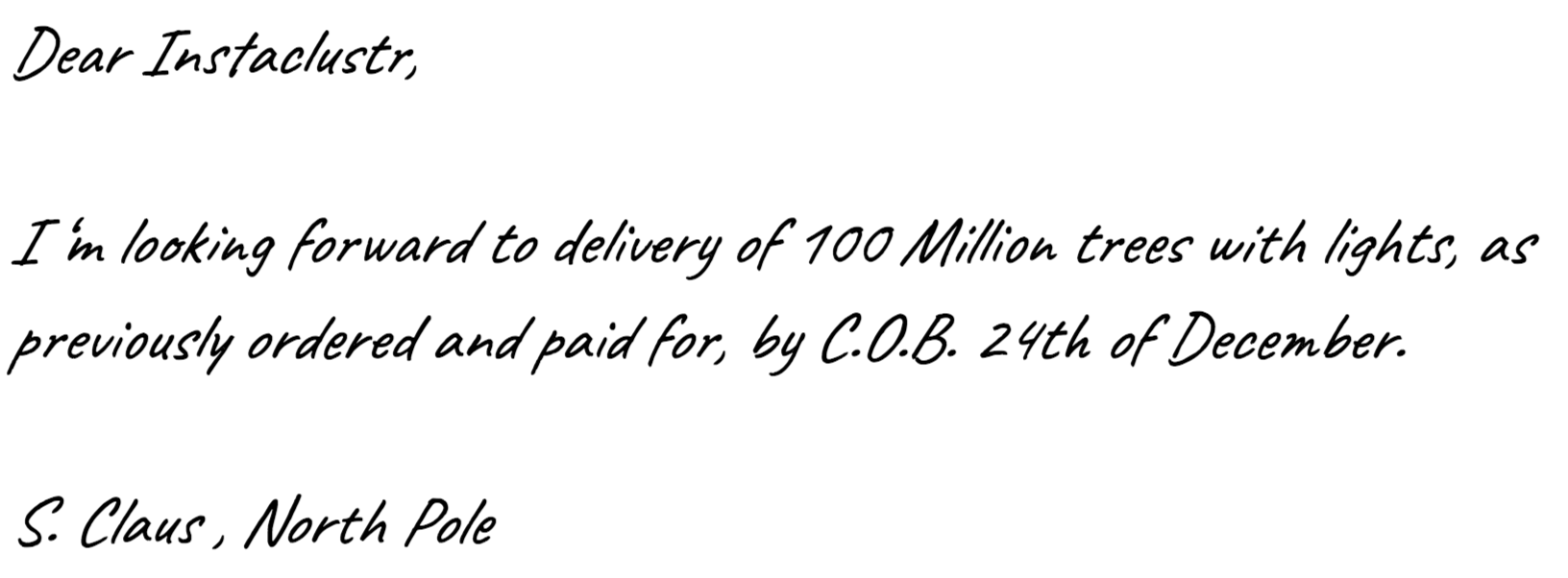
**What would you do if you received a request like this?**
[](https://www.instaclustr.com/wp-content/uploads/2021/10/Apache-Kafka-Christmas-Tree.png)
Looks like poor old Santa confused us with a company that produces Instant Forests. But maybe Santa knew I’d been trying out Decision Tree Machine Learning (including Random Forests) on our performance data (see [previous blogs](https://www.instaclustr.com/blog/third-contact-monolith-part-c-pod/) on [Machine Learning with Spark](https://www.instaclustr.com/blog/fourth-contact-monolith/))?
But then I started thinking. Obviously, Santa is “magic” (what online shop can deliver presents to millions of people on Christmas Eve!), so maybe all I had to do was come up with was a simulated virtual tree and Santa could handle the rest?
Where to start? What (in computer science or mathematics) is tree-shaped?
On the first day of Christmas
my true love sent to me:
A Quincunx machine in a Pear Tree
On the second day of Christmas
my true love sent to me:
2 Bean Machines
And a Quincunx machine in a Pear Tree
On the third day of Christmas
my true love sent to me:
3 Galton Boards
2 Bean Machines
and a Quincunx machine in a Pear Tree
On the fourth day of Christmas
my true love sent to me:
4 Pascal’s Triangles
3 Galton Boards
2 Bean Machines
and a Quincunx machine in a Pear Tree
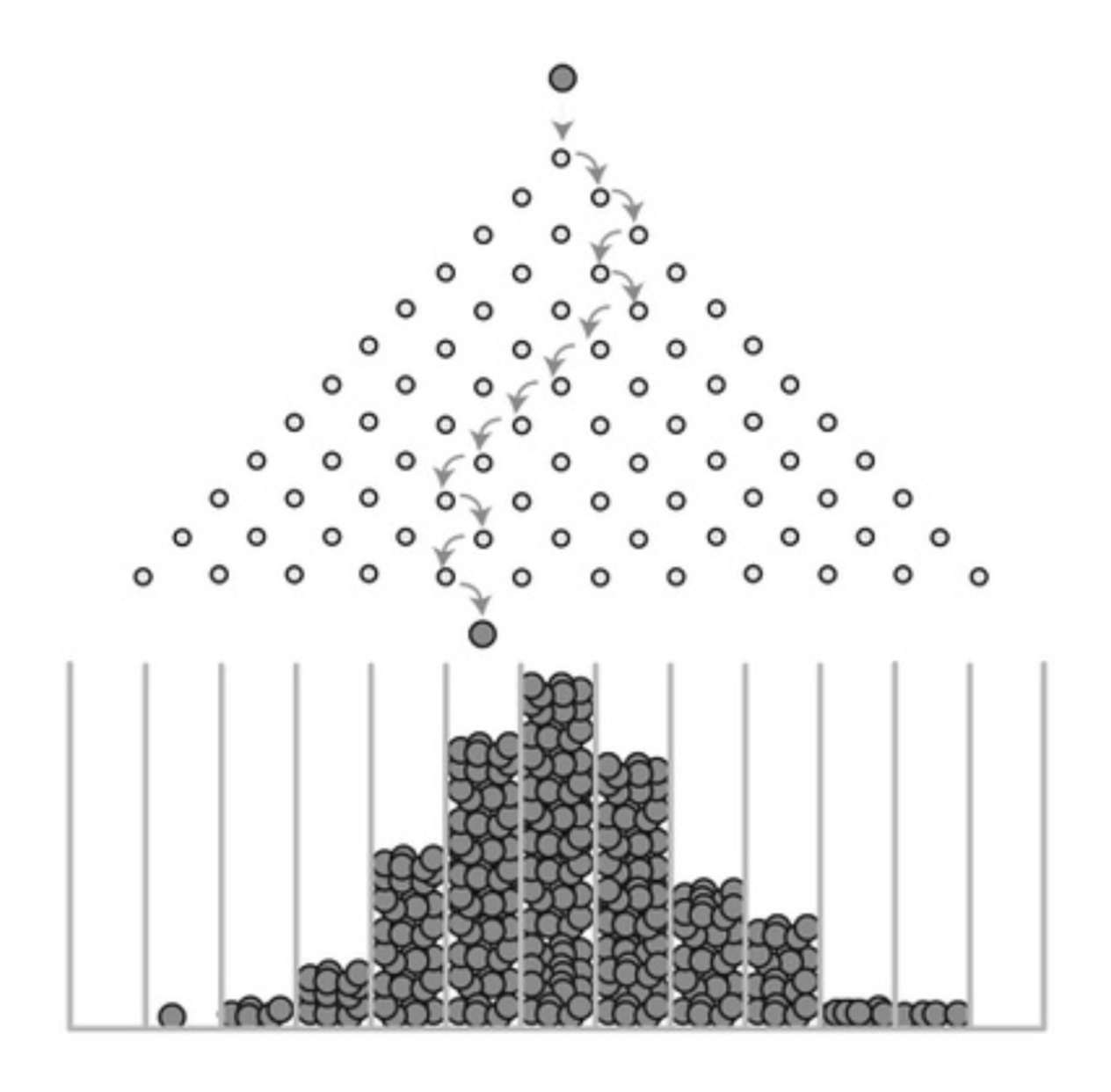
Ok, that’s enough! Ten identical presents are rather boring. A Quincunx machine (also called Bean machine or Galton Board) is a vertical board with nails banged into it in the shape of a Christmas tree.
[](https://www.instaclustr.com/wp-content/uploads/2021/10/Apache-Kafka-Galton-Board.png)
**Here is a clip of one in action.**
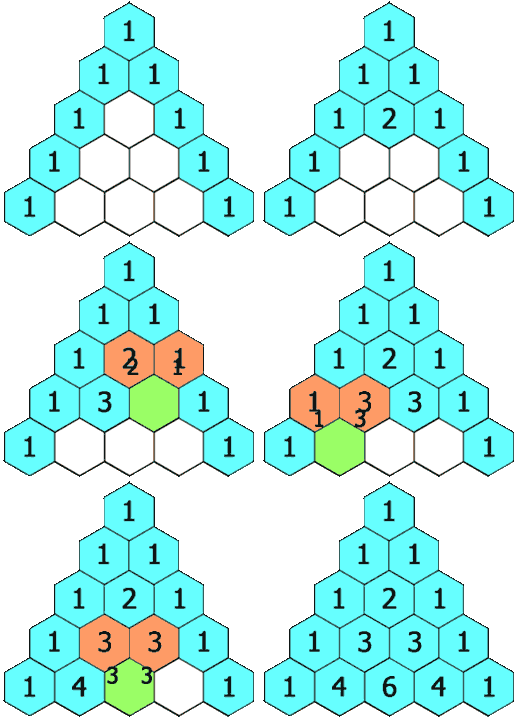
Balls are dropped from the top (where the “Star” would be on a tree), and bounce either left or right as they hit the nails and drop down to the next level, and so on, until they drop out the bottom. They are collected into bins at the bottom and the height of the bins will eventually approximate a bell curve. Overlaying Pascal’s triangle onto the nails shows the number of different paths that can be taken to get to each bin (as each value is the sum of the two values above it to the left and right, starting with a 1 at the top Star position). The bins towards the middle are reached by more paths and will collect more balls:
[](https://www.instaclustr.com/wp-content/uploads/2021/10/PascalTriangleAnimated2.gif)
Obviously, I’m not the first person to connect these ideas. Here’s a [Pascal’s Christmas Tree simulator](https://www.active-maths.co.uk/whiteboard/3sequence/pascal_tree.html), a [Quincunx simulation](https://www.mathsisfun.com/data/quincunx.html), and [this blog does a full The 12 days of Pascal’s triangular Christmas!](https://theconversation.com/the-12-days-of-pascals-triangular-christmas-21479)
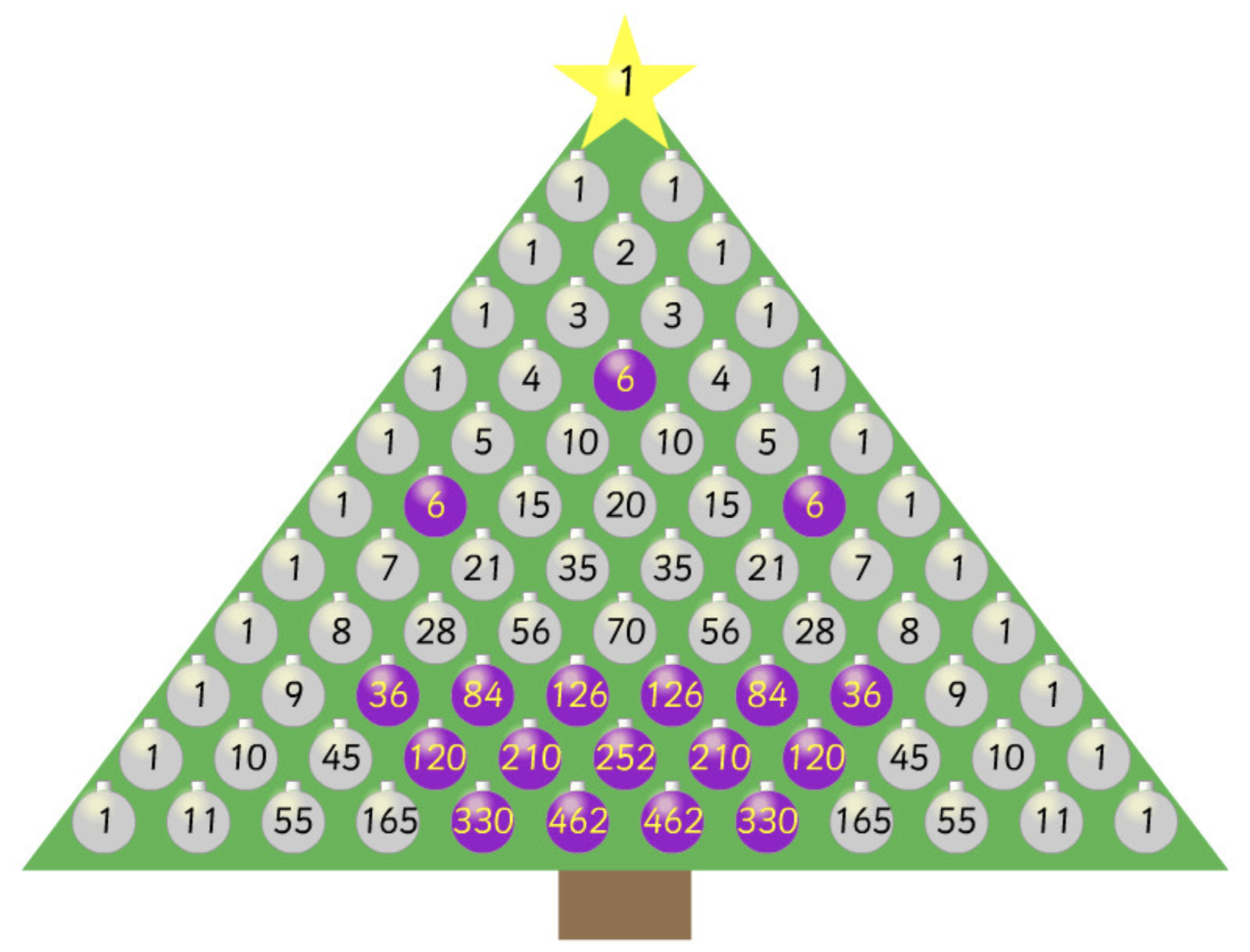
The Pascal’s Christmas tree simulator (image above) inspired me to use a similar approach for a Christmas tree lights simulator. The tree will be a Galton board, with lights at each nail position (baubles in the above picture). The positions are traditionally rows and columns starting from row 0 at the top, and columns starting from 0 on the left. The star is therefore (0,0). A light will be ON if a ball hits the nail, and will stay on for a second, and then turn OFF. Lights will turn on/off (twinkle!) as balls enter from the top, and drop down to the bottom. If balls drop in fast enough then multiple lights will be on at once.
Time to open up an early Christmas present (Kafka, which is on the Instaclustr roadmap for 2018) and use it to write a scalable Christmas tree lights simulation. Some imagination may be required (perhaps enhanced with a few glasses of Christmas port).
The design choices I had to make were around the number of producers, consumers and topics, what roles they would have, what the message structure would be, and how to handle time.
We’ll start with a single Kafka Producer to drop balls onto the top of the tree (at the Star), with a new ball arriving every second. The “star” is just a simple java producer running in a thread which sends a (0,0) message to the “tree” topic, and sleeps for a second before repeating until the desired number of balls have been released.
[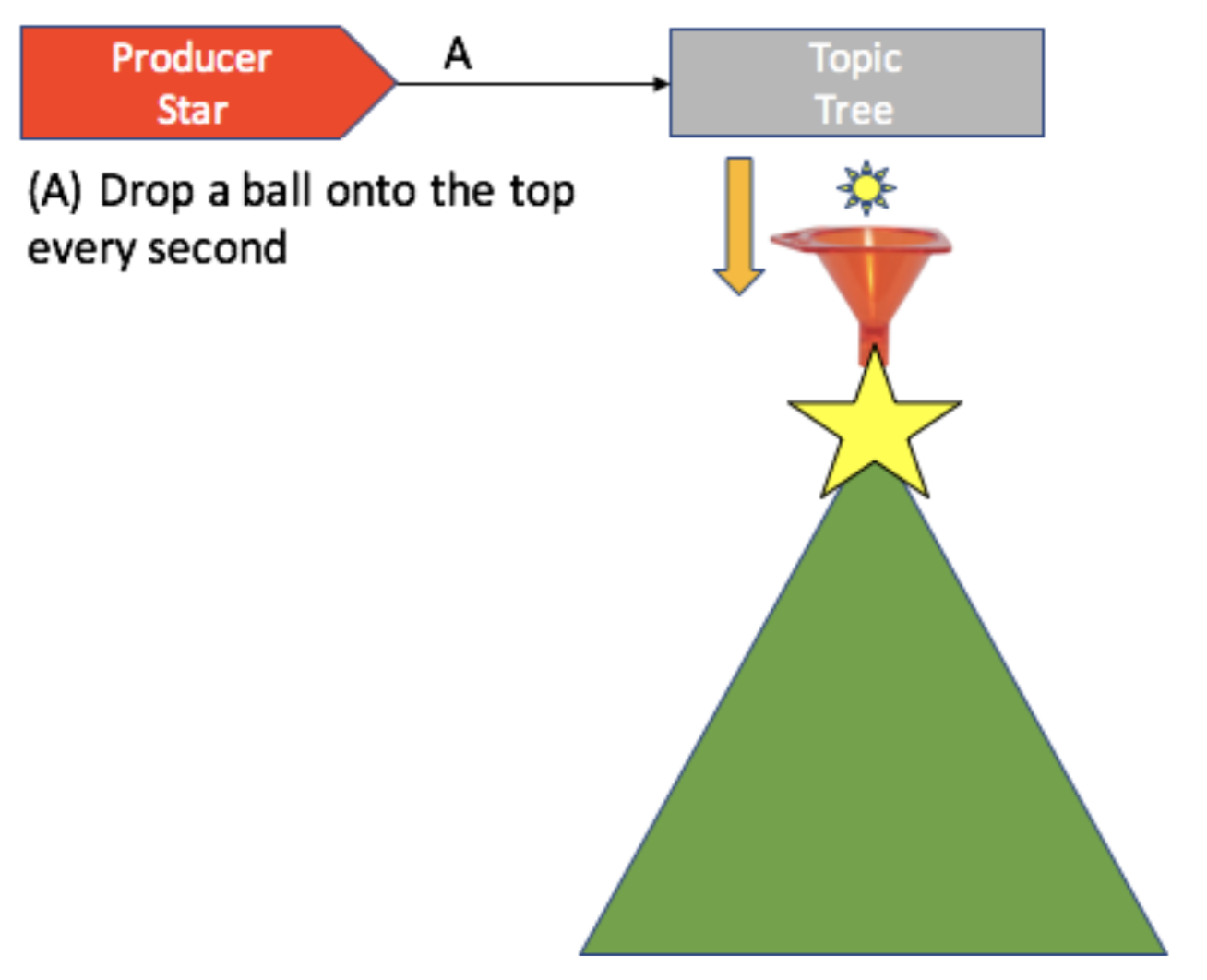](https://www.instaclustr.com/wp-content/uploads/2021/10/Kafka-Christmas-Tree.png)
Initially, I had thought of using multiple topics to capture the topology of the relationship between the lights, but his would have been too complicated for larger trees. A simpler solution using a single topic (called “tree”) is more obvious. I also decided on a very simple message structure using the Kafka message *key* as the row value, and the message *value* as the column. Note that for multiple partition topics this may not be ideal as the key is used for distributing messages across partitions and the small number of row values may not result in a good hash function.
Currently the tree only has the top starlight illuminated all the time. What’s missing? Gravity! To simulate gravity we need a consumer/producer pair, I called this “twinkle”. To twinkle, we receive a message (ball location) from the tree topic, randomly decide if the ball will go left or right, and then publish a message consisting of the new location back to the “tree” topic. Will this work? Not really. This is just an infinite loop, what we really need is a delay queue or explicit timestamp handling, so we can delay the processing of the new ball location until the 1 second ON time has elapsed. A hack for this is to sleep the Twinkle application consumer thread so it only checks for new messages periodically. This is what we have so far.
[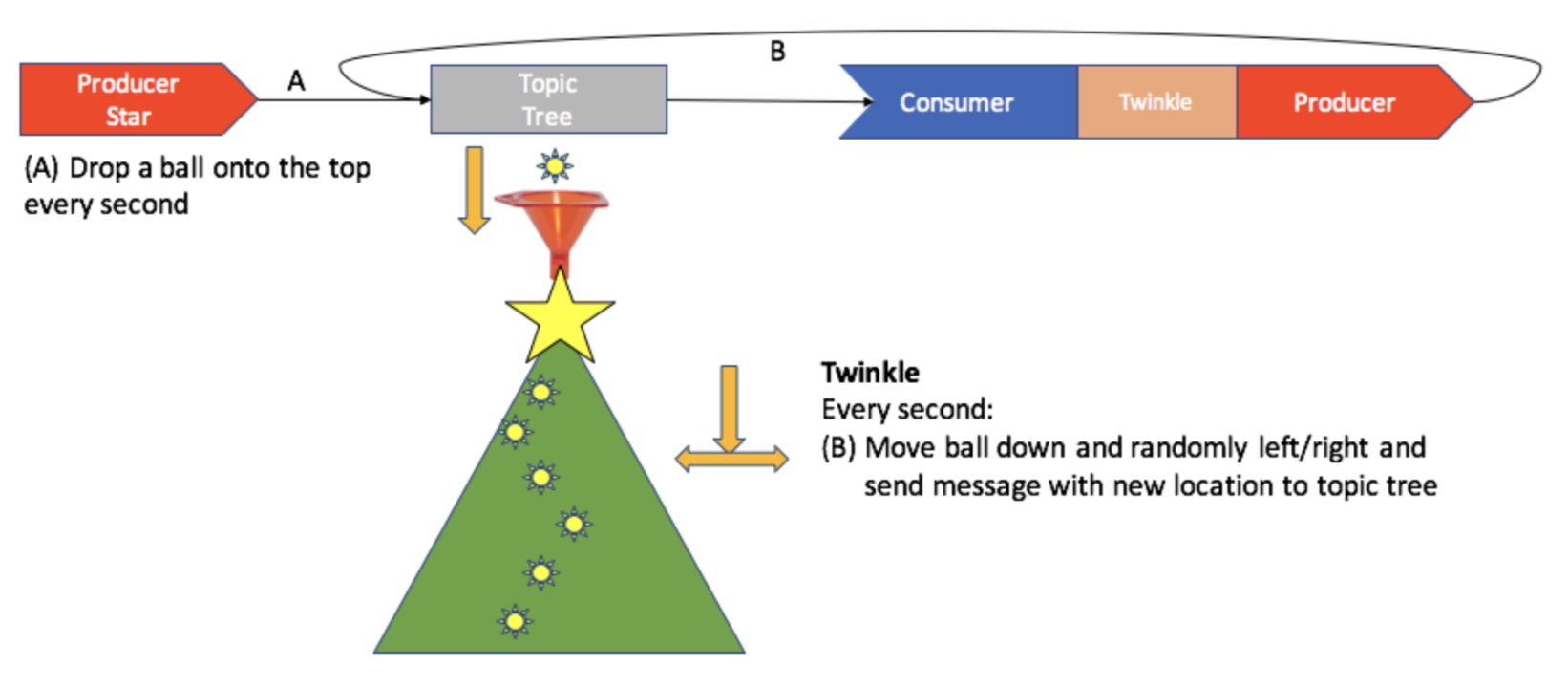](https://www.instaclustr.com/wp-content/uploads/2021/10/Apache-kafka-Christmas-Tree1.png)
What’s missing? What should we do with balls that reach the bottom of the tree (the last row)? We could just make them vanish (by not sending a message back to the tree topic). Or better (in the spirit of the Galton Board) let’s add a “count” topic and a Count Consumer to add up the number of balls that fall into each bin under the tree:
[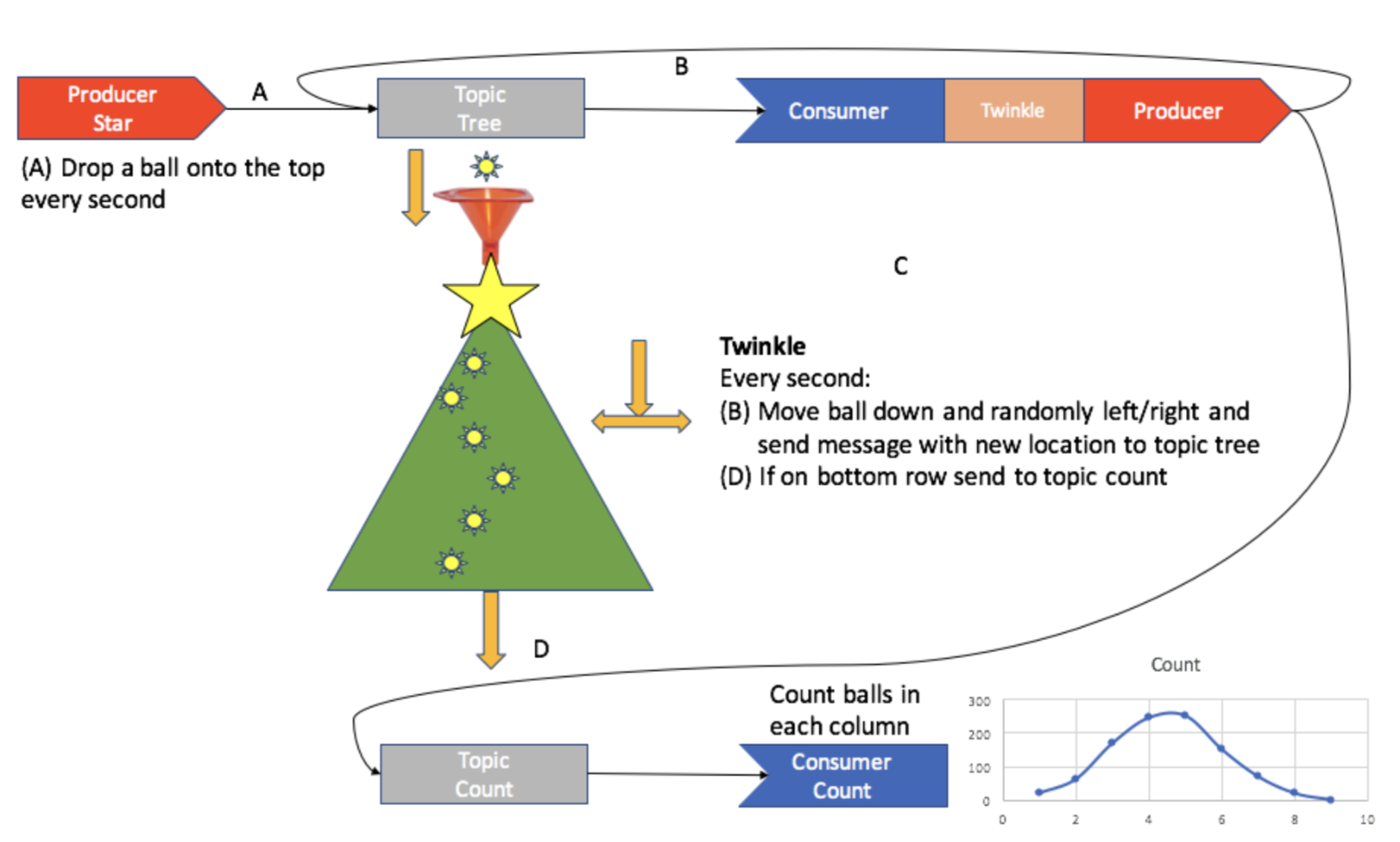](https://www.instaclustr.com/wp-content/uploads/2021/10/Apache-Kafka-Galton-Board-Christmas-Tree.png)
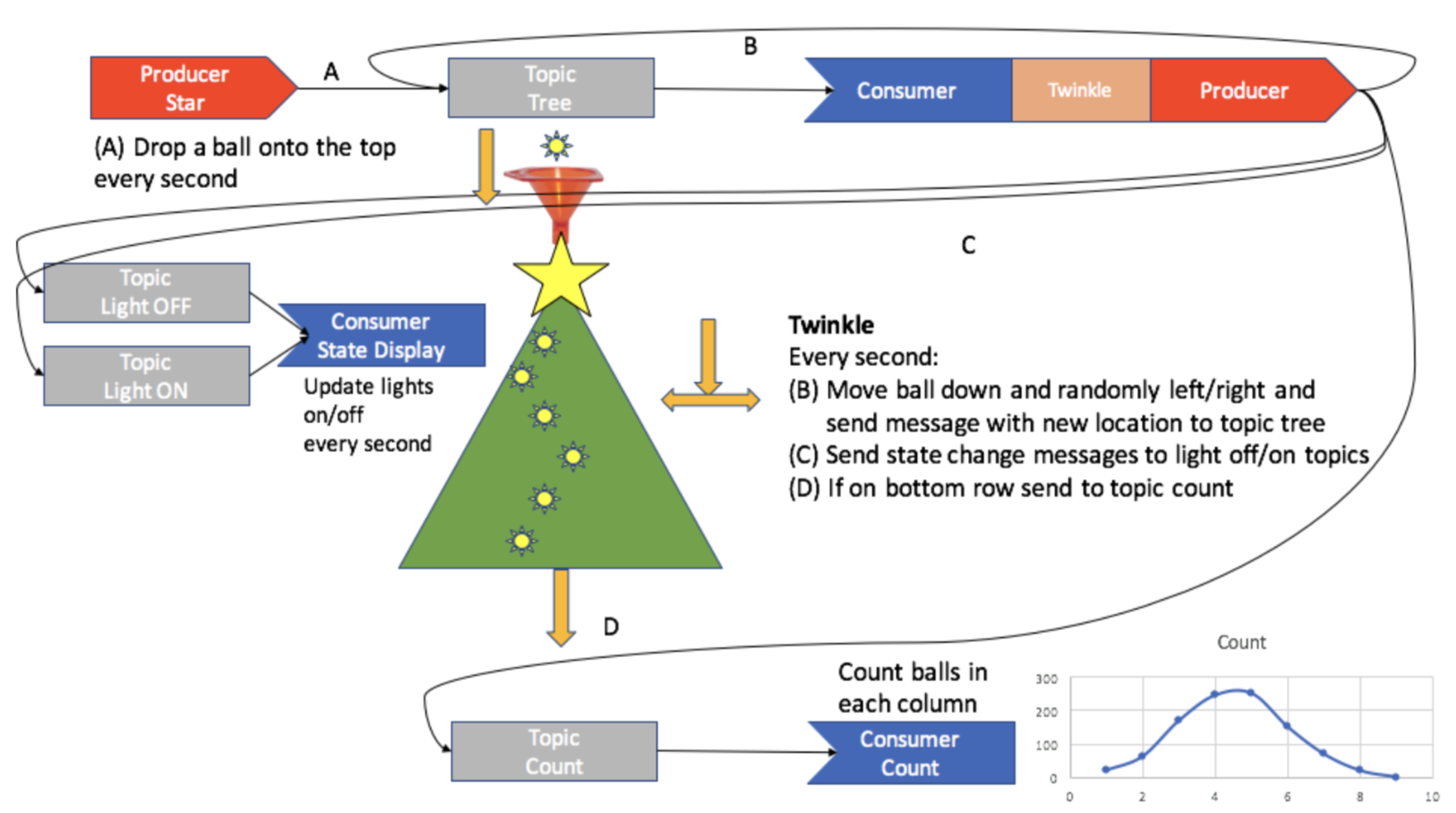
The final problem is how to display the tree and lights state? The simplest solution is to have another consumer which subscribes to the “tree” topic and changes the state of the correct lights for each new message in the topic (change of ball location). This is possible and was the approach I tried first. However, the Twinkle and Display consumers have to be in different consumer groups (because of the way the Kafka protocol works, to ensure that they both get every message published to the tree topic), and computing the state and handling timing was tricky:
[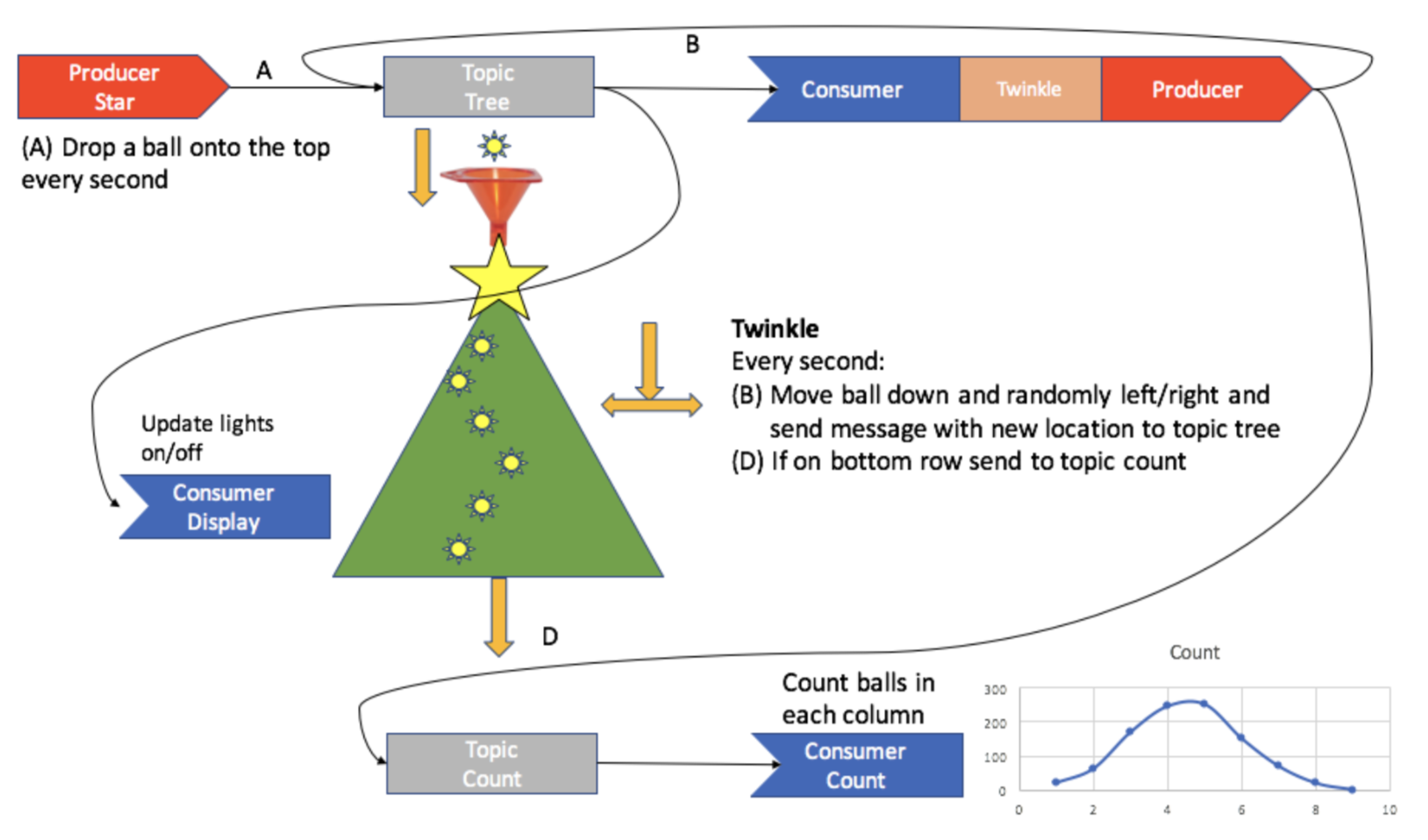](https://www.instaclustr.com/wp-content/uploads/2021/10/Apache-Kafka-Galton-Christmas-Board-Diagram.png)
An improved version computes the state change of the lights in the Tinkle application (step C), and sends a state change message (light location OFF or ON) to the corresponding dedicated topic (Light OFF, Light ON). Every second, the State Display consumer applies all the OFF messages first, and then the ON messages, and then prints the tree lights state (in ASCII). Each “\*” is an ON light ON, each “.” is an OFF light.
[](https://www.instaclustr.com/wp-content/uploads/2021/10/Apache-Kafka-Christmas-Tree-Diagram.png)
Here’s a sequence that could be printed for a simple tree with 3 rows, and a single ball dropped in at the top:
Time 1: star lights up (0,0)
\*
..
…
-----------
Time 2: light at (1,1) ON
.
.\*
…
-----------
Time 3: light at (2,1) ON
.
..
.\*.
-------------
Time 4: All lights OFF
.
..
…
----------
Here’s an (edited) run with 10 rows and 100 balls:
Welcome to the Instaclustr XMAS Tree Simulator!!!!!
\*
..
…
….
…..
……
…….
……..
………
……….
-----------------------------------------------------
Etc (lots of balls)
**\***
**\*\***
**\*\*.**
**.\*\*.**
**..\*\*.**
**..\*\*\*.**
**…\*\*..**
**\*..\*\*…**
**\*..\*…..**
**..\*.\*\*\*…**
-----------------------------------------------------------------------------------------------------------------------------------------
Etc (no more balls arriving, eventually end up with all lights OFF)
.
..
…
….
..\*..
..\*\*..
..\*\*…
..\*\*….
…\*\*….
…..\*\*…
-----------------------------------------------------------------------------
A Happy Normally Distributed Xmas! Counts:
col 0 = 1
col 1 = 2
col 2 = 7
col 3 = 19
col 4 = 28
col 5 = 25
col 6 = 14
col 7 = 4
col 8 = 0
col 9 = 0
Total events counted = 100
More interesting christmas lights with colour could have been simulated by using a richer message structure, e.g. a message number as the key, and a compound value type consisting of (row, col, colour).
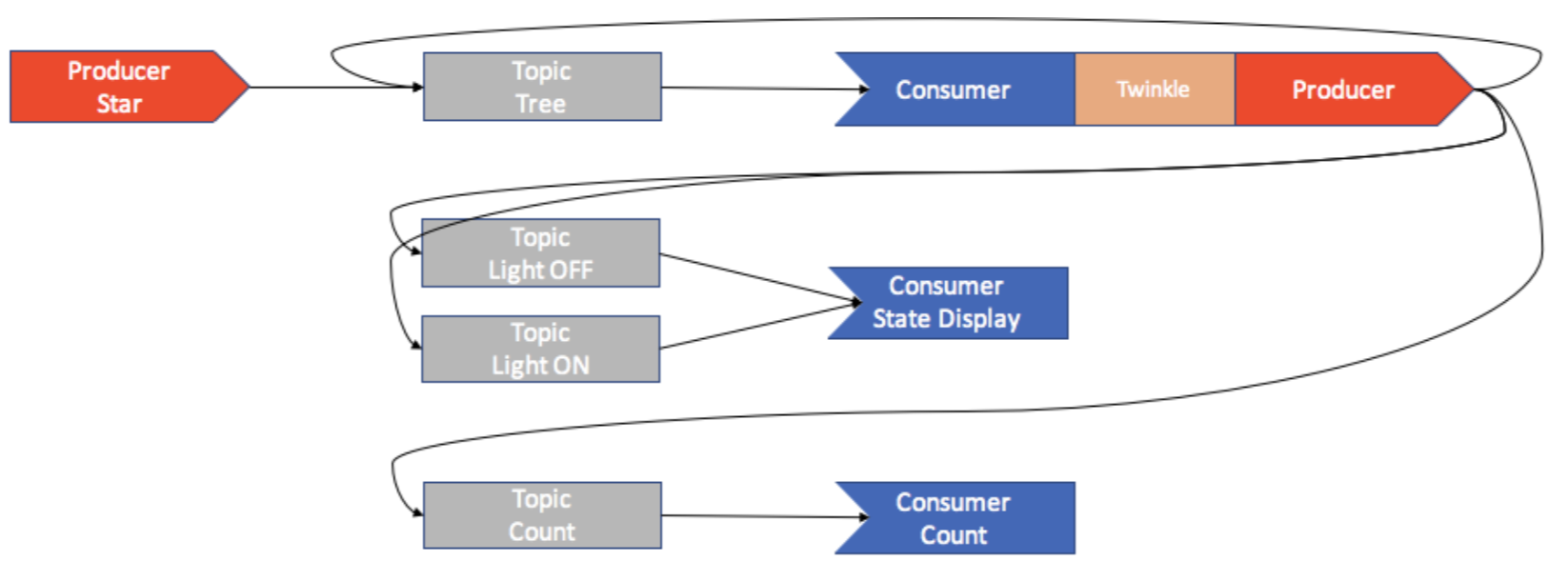
Here’s a simplified topology diagram showing just the relationship between producers, topics and consumers.
[](https://www.instaclustr.com/wp-content/uploads/2021/10/Apache-Kafka-Simplified-topology-diagram.png)
Is this the best/correct approach for:
- Computing and keeping track of the state of the lights?
- Probably not. Kafka streams and a KTable (which maintains state) may be better. [Here’s a blog.](https://danlebrero.com/2017/01/05/proof-of-concept-using-kafkastreams-and-ktables/)
- Handling time?
- Probably not. As I mentioned, using a delay queue or explicit timestamp handling would be better. Essentially I’m using Kafka as a discrete event simulation (DES) which it isn’t really designed for, but in theory, it should work as all you need is events and timestamps. I (briefly) tried using the different timestamp extractors but had a few issues, I suspect that they are designed to work (best) with Kafka streams. So maybe Santa could get a few elves to add some code for this, perhaps using windows.
Will Santa be happy with this? He should be! Given that it’s written in Kafka it will scale massively. It should be easy to increase the speed of the simulation (i.e. run it flat out), increase the size of the tree, and even simulate a forest of trees, each with a slightly different algorithm and/or starting condition, and multiple different ways of displaying the tree/lights. There’s also *reprocessing* ([that I mentioned in this blog](https://www.instaclustr.com/blog/picknmix-cassandra-spark-zeppelin-elassandra-kibana-kafka/)), where Kafka persists all the messages, so consumers can choose which messages to process. Consumers could display any historic state of the tree lights.
Canberra was in the news a few years ago with a charity fundraising [world record for the number of lights on an artificial Christmas tree.](https://www.guinnessworldrecords.com/news/2015/11/christmas-mad-aussie-david-richards-sets-tree-lights-display-world-record-407689) What does ½ a million lights look like?
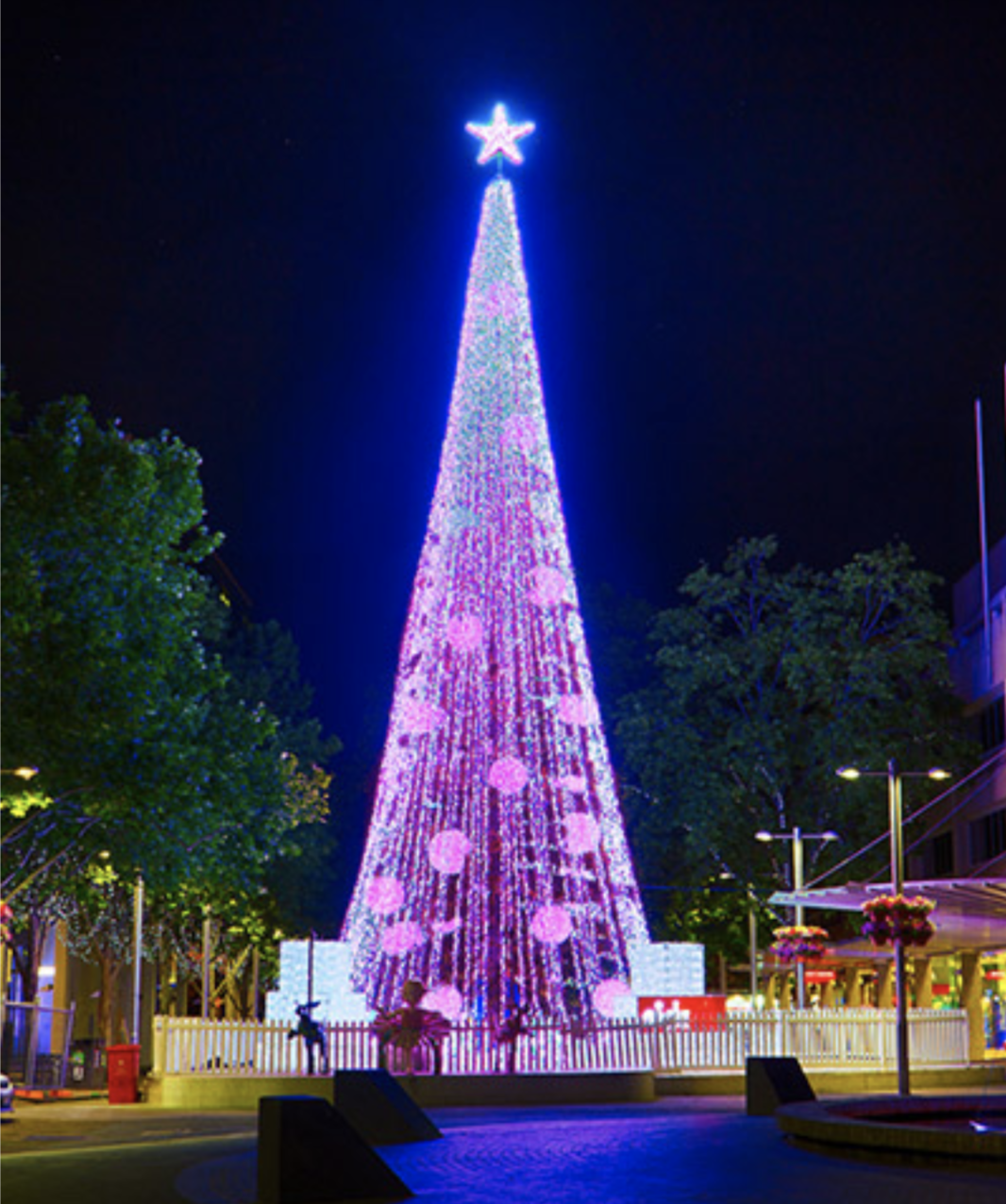
I just had to see if the Kafka Christmas lights simulator was up to the challenge. It was.
A simulated tree with 500,000 lights and 100,000 balls dropped in ran in 555s, processed over 400 million producer + consumer events, and ran 180 times faster than real-time (running flat out), achieving an average throughput of 43 million events per minute, not bad with everything (Kafka broker and java code) running on my laptop. Why stop there? 1 million and 2 million worked fine, can I claim the world record for the most lights on a *simulated* Christmas tree?
Here’s the code (Java). Note that I made a minor change to the twinkle application to correctly process the Star light. The Star producer now sends a special message (-1, -1) to Twinkle which interprets this as a special case, i.e. an arriving ball with no location yet, and sends a message back to the tree topic with the star location (0,0) and a (0,0) message to the Light ON topic.
Please check out our [Spark Streaming, Kafka and Cassandra Tutorial](https://www.instaclustr.com/support/documentation/cassandra-add-ons/apache-spark/spark-streaming-kafka-and-cassandra-tutorial/) for details on installing and running Kafka and Zookeeper and visit our [GitHub](https://github.com/instaclustr/Kafka-Xmas-Tree-Blog) to access all Java Code.
Java Kafka Code
---------------
Java
KafkaProperties.java: package kafkaxmas; public class KafkaProperties { public static final Boolean DEBUG = false; public static final Boolean DISPLAY = true; public static final String KAFKA\_SERVER\_URL = "localhost"; public static final int KAFKA\_SERVER\_PORT = 9092; public static final int KAFKA\_PRODUCER\_BUFFER\_SIZE = 64 \* 1024; public static final int CONNECTION\_TIMEOUT = 100000; public static final int DELAY = 1000; public static final String TOPIC = "topicTree"; public static final String TOPIC2 = "topicCount"; public static final String TOPICOFF = "topicOff"; public static final String TOPICON = "topicOn"; public static final String CLIENT\_ID = "KafkaXmasTreeDemo"; public static final int TREE\_ROWS = 10; public static final int BALLS = 1000; private KafkaProperties() {} } XmasTree.java: package kafkaxmas; /\* \* Top level main program to run Xmas Tree Simulation. \* start star producer, twinkle consumer/producer, and consumers for count and display. \*/ public class XmasTree { public static void main(String\[\] args) { boolean isAsync = args.length == 0 || !args\[0\].trim().equalsIgnoreCase("sync"); System.out.println("Welcome to the Instaclustr XMAS Tree Simulator!!!!!"); // Start balls dropping onto top of tree. StarProducer producerThread = new StarProducer(KafkaProperties.TOPIC, isAsync); producerThread.start(); // Start state display consumer. New version with both topics, OFF and ON, passed via args. StateDisplayConsumer displayTree = new StateDisplayConsumer(KafkaProperties.TOPICOFF, KafkaProperties.TOPICON); displayTree.start(); // start count consumer, subscribes to TOPIC2 CountConsumer counts = new CountConsumer(KafkaProperties.TOPIC2); counts.start(); // start twinkle consumer/producer application, subscribe to same topic as the star producer. Twinkle twinkleThread = new Twinkle(KafkaProperties.TOPIC); twinkleThread.start(); // Note that even though the star producer eventually stops, the other threads keep running for ever. } } StarProducer.java: package kafkaxmas; import org.apache.kafka.clients.producer.Callback; import org.apache.kafka.clients.producer.KafkaProducer; import org.apache.kafka.clients.producer.ProducerRecord; import org.apache.kafka.clients.producer.RecordMetadata; import java.util.Properties; import java.util.concurrent.ExecutionException; // Producer which drops balls onto the top of the tree. // Drop one "ball" onto top of tree every DELAY period, stops when number of balls dropped == BALLS. // Message is of format: key=row, value=col // Changed to send (-1, -1) rather than the original (0, 0), to indicate that the ball needs to be processed specially by Twinkle. public class StarProducer extends Thread { private final KafkaProducer<Integer, Integer> producer; private final String topic; private final Boolean isAsync; private final Boolean debug = KafkaProperties.DEBUG; private final long zeroTime = System.currentTimeMillis(); public StarProducer(String topic, Boolean isAsync) { Properties props = new Properties(); props.put("bootstrap.servers", KafkaProperties.KAFKA\_SERVER\_URL + ":" + KafkaProperties.KAFKA\_SERVER\_PORT); props.put("client.id", "StarProducer"); props.put("key.serializer", "org.apache.kafka.common.serialization.IntegerSerializer"); props.put("value.serializer", "org.apache.kafka.common.serialization.IntegerSerializer"); producer = new KafkaProducer<>(props); this.topic = topic; this.isAsync = isAsync; } public void run() { int messageNo = 1; int maxMessages = KafkaProperties.BALLS; while (messageNo <= maxMessages) { int row = -1; int col = -1; long startTime = System.currentTimeMillis(); if (isAsync) { // Send asynchronously producer.send(new ProducerRecord<>(topic, row, col), new DemoCallBack(startTime, row, col)); } else { // Send synchronously try { producer.send(new ProducerRecord<>(topic, row, col)).get(); if (debug) System.out.println("Sent message: (" + row + ", " + col + ")"); } catch (InterruptedException | ExecutionException e) { e.printStackTrace(); } } ++messageNo; long nowTime = System.currentTimeMillis(); if (debug) System.out.println("Star \*\*\* " + (nowTime - zeroTime) + ": " + messageNo); try { Thread.sleep(KafkaProperties.DELAY); } catch (InterruptedException e) { e.printStackTrace(); } } } } class DemoCallBack implements Callback { private final long startTime; private final int key; private final int message; public DemoCallBack(long startTime, int key, int message) { this.startTime = startTime; this.key = key; this.message = message; } public void onCompletion(RecordMetadata metadata, Exception exception) { long elapsedTime = System.currentTimeMillis() - startTime; if (metadata != null) { System.out.println( "message(" + key + ", " + message + ") sent to partition(" + metadata.partition() + "), " + "offset(" + metadata.offset() + ") in " + elapsedTime + " ms"); } else { exception.printStackTrace(); } } } Twinkle.java: package kafkaxmas; import kafka.utils.ShutdownableThread; import org.apache.kafka.clients.consumer.ConsumerConfig; import org.apache.kafka.clients.consumer.ConsumerRecord; import org.apache.kafka.clients.consumer.ConsumerRecords; import org.apache.kafka.clients.consumer.KafkaConsumer; import org.apache.kafka.clients.producer.KafkaProducer; import org.apache.kafka.clients.producer.ProducerRecord; import java.util.Collections; import java.util.Properties; import java.util.Random; /\* \* Consumer/producer Pair. \* Receives from tree topic, sends to count and On/Off state change topics. \* Simulated gravity by reading event from tree topic, transforming it the next row and randomly left or right cols. \* If event is special (-1, -1) value then a new ball has arrived, send new event (0,0) to tree topic and a Light ON state change. \* Else \* Send current position Light OFF state change \* If on bottom row, then send event to count topic. \* Else transform to next row and randomly left or right and send new event to tree topic and light ON state change. \* \* What are valid producer configs? https://kafka.apache.org/documentation.html#producerconfigs \*/ public class Twinkle extends ShutdownableThread { private final KafkaProducer<Integer, Integer> producer; private final KafkaConsumer<Integer, Integer> consumer; private final String topic; Boolean debug = KafkaProperties.DEBUG; int maxRow = KafkaProperties.TREE\_ROWS; // size of tree static Random rand = new Random(); boolean display = KafkaProperties.DISPLAY; // display ASCII tree or not public Twinkle(String topic) { super("Twinkle", false); Properties props = new Properties(); props.put(ConsumerConfig.BOOTSTRAP\_SERVERS\_CONFIG, KafkaProperties.KAFKA\_SERVER\_URL + ":" + KafkaProperties.KAFKA\_SERVER\_PORT); props.put(ConsumerConfig.GROUP\_ID\_CONFIG, "Twinkle"); props.put(ConsumerConfig.ENABLE\_AUTO\_COMMIT\_CONFIG, "true"); props.put(ConsumerConfig.AUTO\_COMMIT\_INTERVAL\_MS\_CONFIG, "1000"); props.put(ConsumerConfig.SESSION\_TIMEOUT\_MS\_CONFIG, "30000"); props.put(ConsumerConfig.KEY\_DESERIALIZER\_CLASS\_CONFIG, "org.apache.kafka.common.serialization.IntegerDeserializer"); props.put(ConsumerConfig.VALUE\_DESERIALIZER\_CLASS\_CONFIG, "org.apache.kafka.common.serialization.IntegerDeserializer"); consumer = new KafkaConsumer<>(props); this.topic = topic; consumer.subscribe(Collections.singletonList(this.topic)); // producer, shared across all output topics Properties pprops = new Properties(); pprops.put("bootstrap.servers", KafkaProperties.KAFKA\_SERVER\_URL + ":" + KafkaProperties.KAFKA\_SERVER\_PORT); pprops.put("client.id", "TwinkleProducer"); pprops.put("key.serializer", "org.apache.kafka.common.serialization.IntegerSerializer"); pprops.put("value.serializer", "org.apache.kafka.common.serialization.IntegerSerializer"); producer = new KafkaProducer<>(pprops); } @Override public void doWork() { int row; int col; long pollInterval = 1000; ConsumerRecords<Integer, Integer> records = consumer.poll(pollInterval); for (ConsumerRecord<Integer, Integer> record : records) { if (debug) System.out.println("Twinkle got records = " + records.count()); if (debug) System.out.println("Twinkle: processing record = (" + record.key() + ", " + record.value() + ") at offset " + record.offset()); row = record.key(); col = record.value(); if (row == -1) // ball dropped in from the top, put it in Star location (0,0) and turn it ON for a second { row = 0; col = 0; // put (0,0) into topic and send ON event producer.send(new ProducerRecord<Integer, Integer>(this.topic, row, col)); if (debug) System.out.println("Twinkle STAR ON + (" + row + ", " + col + ") ON"); producer.send(new ProducerRecord<Integer, Integer>(KafkaProperties.TOPICON, row, col)); } else { // turn light OFF in current position if (debug) System.out.println("Twinkle + (" + row + ", " + col + ") OFF"); producer.send(new ProducerRecord<Integer, Integer>(KafkaProperties.TOPICOFF, row, col)); // increment row (gravity!), if row >= maxRow then don't publish back to tree topic, send to count topic instead int nextRow = row + 1; if (nextRow >= maxRow) { if (debug) System.out.println("Twinkle, ball on maxRow!"); // ball drops off bottom, so send event to TOPIC2 for counting producer.send(new ProducerRecord<Integer, Integer>(KafkaProperties.TOPIC2, row, col)); } else // random pick left or right direction and send new location back to tree topic and ON state change // { int nextCol = col; // choose left or right bulb if (rand.nextBoolean()) nextCol += 1; if (debug) System.out.println("Twinkle: next " + nextRow + ", " + nextCol); producer.send(new ProducerRecord<Integer, Integer>(this.topic, nextRow, nextCol)); if (debug) System.out.println("Twinkle + (" + nextRow+ ", " + nextCol + ") ON"); producer.send(new ProducerRecord<Integer, Integer>(KafkaProperties.TOPICON, nextRow, nextCol)); } } } // processed all records obtained in poll above, now sleep for some time so that lights will stay on for a while. try { Thread.sleep(KafkaProperties.DELAY); } catch (InterruptedException e) { e.printStackTrace(); } } @Override public String name() { return null; } @Override public boolean isInterruptible() { return false; } } CountConsumer.java: package kafkaxmas; import kafka.utils.ShutdownableThread; import org.apache.kafka.clients.consumer.ConsumerConfig; import org.apache.kafka.clients.consumer.ConsumerRecord; import org.apache.kafka.clients.consumer.ConsumerRecords; import org.apache.kafka.clients.consumer.KafkaConsumer; import java.util.Collections; import java.util.Properties; // consumer to count the number of balls in each bin when they drop off the bottom public class CountConsumer extends ShutdownableThread { private final KafkaConsumer<Integer, Integer> consumer; private final String topic; private final int maxCols = KafkaProperties.TREE\_ROWS; private long counts\[\] = new long\[maxCols\]; int balls = KafkaProperties.BALLS; // number of balls expected Boolean debug = KafkaProperties.DEBUG; int runningTotal = 0; long startTime = System.currentTimeMillis(); public CountConsumer(String topic) { super("XmasTreeCountConsumer", false); Properties props = new Properties(); props.put(ConsumerConfig.BOOTSTRAP\_SERVERS\_CONFIG, KafkaProperties.KAFKA\_SERVER\_URL + ":" + KafkaProperties.KAFKA\_SERVER\_PORT); props.put(ConsumerConfig.GROUP\_ID\_CONFIG, "XmasTreeCountConsumer"); props.put(ConsumerConfig.ENABLE\_AUTO\_COMMIT\_CONFIG, "true"); props.put(ConsumerConfig.AUTO\_COMMIT\_INTERVAL\_MS\_CONFIG, "1000"); props.put(ConsumerConfig.SESSION\_TIMEOUT\_MS\_CONFIG, "30000"); props.put(ConsumerConfig.KEY\_DESERIALIZER\_CLASS\_CONFIG, "org.apache.kafka.common.serialization.IntegerDeserializer"); props.put(ConsumerConfig.VALUE\_DESERIALIZER\_CLASS\_CONFIG, "org.apache.kafka.common.serialization.IntegerDeserializer"); consumer = new KafkaConsumer<>(props); this.topic = topic; consumer.subscribe(Collections.singletonList(this.topic)); } @Override public void doWork() { long pollInterval = 1000; ConsumerRecords<Integer, Integer> records = consumer.poll(pollInterval); for (ConsumerRecord<Integer, Integer> record : records) { if (debug) System.out.println("Count Consumer records = " + records.count()); if (debug) System.out.println("Count Consumer, Received message: (" + record.key() + ", " + record.value() + ") at offset " + record.offset()); if (record.value() < maxCols) { counts\[record.value()\]++; runningTotal++; } } if (debug) System.out.println("Count = " + runningTotal); // only display counts at end long sum = 0; for (int i=0; i < maxCols; i++) sum += counts\[i\]; if (sum >= balls) { System.out.println("A Happy Normally Distributed Xmas! Counts:"); for (int i=0; i < maxCols; i++) System.out.println("col " + i + " = " + counts\[i\]); System.out.println("Total events counted = " + sum); long endTime = System.currentTimeMillis(); System.out.println("Total time = " + (endTime - startTime)); } try { Thread.sleep(KafkaProperties.DELAY); } catch (InterruptedException e) { e.printStackTrace(); } } @Override public String name() { return null; } @Override public boolean isInterruptible() { return false; } } StateDisplayConsumer.java: package kafkaxmas; import kafka.utils.ShutdownableThread; import org.apache.kafka.clients.consumer.ConsumerConfig; import org.apache.kafka.clients.consumer.ConsumerRecord; import org.apache.kafka.clients.consumer.ConsumerRecords; import org.apache.kafka.clients.consumer.KafkaConsumer; import java.util.Arrays; import java.util.Collections; import java.util.Properties; /\* \* Consumer for the tree display, receives events from ON and OFF topics and displays ASCII tree. \* Modified version, single consumer subscribes to 2 topics and uses records method to return events for each topic in turn. \* Consumer docs: https://kafka.apache.org/0100/javadoc/index.html?org/apache/kafka/clients/consumer/KafkaConsumer.html \* Consumer config docs: https://kafka.apache.org/documentation.html#consumerconfigs \*/ public class StateDisplayConsumer extends ShutdownableThread { private final KafkaConsumer<Integer, Integer> consumer; private final Boolean debug = KafkaProperties.DEBUG; private final String topic1; private final String topic2; // all lights off by default (false) private final int maxRows = KafkaProperties.TREE\_ROWS; private final int maxCols = maxRows; private final boolean\[\]\[\] tree = new boolean\[maxRows\]\[maxCols\]; public StateDisplayConsumer(String topic1, String topic2) { super("XmasTreeStateDisplayConsumer", false); Properties props = new Properties(); props.put(ConsumerConfig.BOOTSTRAP\_SERVERS\_CONFIG, KafkaProperties.KAFKA\_SERVER\_URL + ":" + KafkaProperties.KAFKA\_SERVER\_PORT); props.put(ConsumerConfig.GROUP\_ID\_CONFIG, "XmasTreeStateDisplayConsumer"); props.put(ConsumerConfig.ENABLE\_AUTO\_COMMIT\_CONFIG, "true"); props.put(ConsumerConfig.AUTO\_COMMIT\_INTERVAL\_MS\_CONFIG, "1000"); props.put(ConsumerConfig.SESSION\_TIMEOUT\_MS\_CONFIG, "30000"); props.put(ConsumerConfig.KEY\_DESERIALIZER\_CLASS\_CONFIG, "org.apache.kafka.common.serialization.IntegerDeserializer"); props.put(ConsumerConfig.VALUE\_DESERIALIZER\_CLASS\_CONFIG, "org.apache.kafka.common.serialization.IntegerDeserializer"); consumer = new KafkaConsumer<>(props); this.topic1 = topic1; this.topic2 = topic2; consumer.subscribe(Arrays.asList(topic1, topic2)); } @Override public void doWork() { // compute current state of lights from OFF and ON messages // Process events in OFF Topic first so if a light changes from OFF to ON instantaneously it will stay on. long pollInterval = 1000; // get records for all topics ConsumerRecords<Integer, Integer> recordsAll = consumer.poll(pollInterval); // get records for OFF topic only //ConsumerRecords<Integer, Integer> recordsOFF = (ConsumerRecords<Integer, Integer>) recordsAll.records(KafkaProperties.TOPICOFF); Iterable<ConsumerRecord<Integer, Integer>> recordsOFF = recordsAll.records(topic1); for (ConsumerRecord<Integer, Integer> record : recordsOFF) { //if (debug) System.out.println("Display Consumer OFF records = " + recordsOFF.count()); if (debug) System.out.println("Display Consumer, OFF Received message: (" + record.key() + ", " + record.value() + ") at offset " + record.offset()); // paranoid check in case we had a bigger tree in a previous run and some messages are still hanging around unprocessed. if (record.key() < maxRows && record.value() < maxCols) tree\[record.key()\]\[record.value()\] = false; } // Now process ON topic messages Iterable<ConsumerRecord<Integer, Integer>> recordsON = recordsAll.records(topic2); //consumer.subscribe(Collections.singletonList(KafkaProperties.TOPICON)); // ConsumerRecords<Integer, Integer> records2 = consumer.poll(pollInterval); for (ConsumerRecord<Integer, Integer> record : recordsON) { //if (debug) System.out.println("Display Consumer ON records = " + recordsON.count()); if (debug) System.out.println("Display Consumer, ON Received message: (" + record.key() + ", " + record.value() + ") at offset " + record.offset()); // paranoid check in case we had a bigger tree in a previous run and some messages are still hanging around unprocessed. if (record.key() < maxRows && record.value() < maxCols) tree\[record.key()\]\[record.value()\] = true; } // display tree as ASCII for (int i=0; i < maxRows; i++) { int indent = (maxRows/2) - (i/2); for (int a=0; a < indent; a++) System.out.print(" "); for (int j=0; j <= i; j++) { if (tree\[i\]\[j\]) System.out.print("\*"); else System.out.print("."); } System.out.println(); } // only display the tree every second try { Thread.sleep(KafkaProperties.DELAY); } catch (InterruptedException e) { e.printStackTrace(); } } @Override public String name() { return null; } @Override public boolean isInterruptible() { return false; } }
1
2
3
4
5
6
7
8
9
10
11
12
13
14
15
16
17
18
19
20
21
22
23
24
25
26
27
28
29
30
31
32
33
34
35
36
37
38
39
40
41
42
43
44
45
46
47
48
49
50
51
52
53
54
55
56
57
58
59
60
61
62
63
64
65
66
67
68
69
70
71
72
73
74
75
76
77
78
79
80
81
82
83
84
85
86
87
88
89
90
91
92
93
94
95
96
97
98
99
100
101
102
103
104
105
106
107
108
109
110
111
112
113
114
115
116
117
118
119
120
121
122
123
124
125
126
127
128
129
130
131
132
133
134
135
136
137
138
139
140
141
142
143
144
145
146
147
148
149
150
151
152
153
154
155
156
157
158
159
160
161
162
163
164
165
166
167
168
169
170
171
172
173
174
175
176
177
178
179
180
181
182
183
184
185
186
187
188
189
190
191
192
193
194
195
196
197
198
199
200
201
202
203
204
205
206
207
208
209
210
211
212
213
214
215
216
217
218
219
220
221
222
223
224
225
226
227
228
229
230
231
232
233
234
235
236
237
238
239
240
241
242
243
244
245
246
247
248
249
250
251
252
253
254
255
256
257
258
259
260
261
262
263
264
265
266
267
268
269
270
271
272
273
274
275
276
277
278
279
280
281
282
283
284
285
286
287
288
289
290
291
292
293
294
295
296
297
298
299
300
301
302
303
304
305
306
307
308
309
310
311
312
313
314
315
316
317
318
319
320
321
322
323
324
325
326
327
328
329
330
331
332
333
334
335
336
337
338
339
340
341
342
343
344
345
346
347
348
349
350
351
352
353
354
355
356
357
358
359
360
361
362
363
364
365
366
367
368
369
370
371
372
373
374
375
376
377
378
379
380
381
382
383
384
385
386
387
388
389
390
391
392
393
394
395
396
397
398
399
400
401
402
403
404
405
406
407
408
409
410
411
412
413
414
415
416
417
418
419
420
421
422
423
424
425
426
427
428
429
430
431
432
433
434
435
436
437
438
439
440
441
442
443
444
445
446
447
448
449
450
451
452
453
454
455
456
457
458
459
460
461
462
463
464
465
466
467
468
469
470
471
472
473
474
475
476
477
478
479
480
481
482
483
484
485
486
487
488
489
490
491
492
493
494
495
496
497
498
499
KafkaProperties.java:
package kafkaxmas;
public class KafkaProperties {
public static final Boolean DEBUG = false;
public static final Boolean DISPLAY = true;
public static final String KAFKA\_SERVER\_URL = "localhost";
public static final int KAFKA\_SERVER\_PORT = 9092;
public static final int KAFKA\_PRODUCER\_BUFFER\_SIZE = 64 \* 1024;
public static final int CONNECTION\_TIMEOUT = 100000;
public static final int DELAY = 1000;
public static final String TOPIC = "topicTree";
public static final String TOPIC2 = "topicCount";
public static final String TOPICOFF = "topicOff";
public static final String TOPICON = "topicOn";
public static final String CLIENT\_ID = "KafkaXmasTreeDemo";
public static final int TREE\_ROWS = 10;
public static final int BALLS = 1000;
private KafkaProperties() {}
}
XmasTree.java:
package kafkaxmas;
/\*
\* Top level main program to run Xmas Tree Simulation.
\* start star producer, twinkle consumer/producer, and consumers for count and display.
\*/
public class XmasTree {
public static void main(String\[\] args) {
boolean isAsync = args.length == 0 || !args\[0\].trim().equalsIgnoreCase("sync");
System.out.println("Welcome to the Instaclustr XMAS Tree Simulator!!!!!");
// Start balls dropping onto top of tree.
StarProducer producerThread = new StarProducer(KafkaProperties.TOPIC, isAsync);
producerThread.start();
// Start state display consumer. New version with both topics, OFF and ON, passed via args.
StateDisplayConsumer displayTree = new StateDisplayConsumer(KafkaProperties.TOPICOFF, KafkaProperties.TOPICON);
displayTree.start();
// start count consumer, subscribes to TOPIC2
CountConsumer counts = new CountConsumer(KafkaProperties.TOPIC2);
counts.start();
// start twinkle consumer/producer application, subscribe to same topic as the star producer.
Twinkle twinkleThread = new Twinkle(KafkaProperties.TOPIC);
twinkleThread.start();
// Note that even though the star producer eventually stops, the other threads keep running for ever.
}
}
StarProducer.java:
package kafkaxmas;
import org.apache.kafka.clients.producer.Callback;
import org.apache.kafka.clients.producer.KafkaProducer;
import org.apache.kafka.clients.producer.ProducerRecord;
import org.apache.kafka.clients.producer.RecordMetadata;
import java.util.Properties;
import java.util.concurrent.ExecutionException;
// Producer which drops balls onto the top of the tree.
// Drop one "ball" onto top of tree every DELAY period, stops when number of balls dropped == BALLS.
// Message is of format: key=row, value=col
// Changed to send (-1, -1) rather than the original (0, 0), to indicate that the ball needs to be processed specially by Twinkle.
public class StarProducer extends Thread {
private final KafkaProducer<Integer, Integer> producer;
private final String topic;
private final Boolean isAsync;
private final Boolean debug = KafkaProperties.DEBUG;
private final long zeroTime = System.currentTimeMillis();
public StarProducer(String topic, Boolean isAsync) {
Properties props = new Properties();
props.put("bootstrap.servers", KafkaProperties.KAFKA\_SERVER\_URL + ":" + KafkaProperties.KAFKA\_SERVER\_PORT);
props.put("client.id", "StarProducer");
props.put("key.serializer", "org.apache.kafka.common.serialization.IntegerSerializer");
props.put("value.serializer", "org.apache.kafka.common.serialization.IntegerSerializer");
producer = new KafkaProducer<>(props);
this.topic = topic;
this.isAsync = isAsync;
}
public void run() {
int messageNo = 1;
int maxMessages = KafkaProperties.BALLS;
while (messageNo <= maxMessages)
{
int row = -1;
int col = -1;
long startTime = System.currentTimeMillis();
if (isAsync) { // Send asynchronously
producer.send(new ProducerRecord<>(topic,
row,
col), new DemoCallBack(startTime, row, col));
} else { // Send synchronously
try {
producer.send(new ProducerRecord<>(topic,
row,
col)).get();
if (debug) System.out.println("Sent message: (" + row + ", " + col + ")");
} catch (InterruptedException | ExecutionException e) {
e.printStackTrace();
}
}
++messageNo;
long nowTime = System.currentTimeMillis();
if (debug) System.out.println("Star \*\*\* " + (nowTime - zeroTime) + ": " + messageNo);
try {
Thread.sleep(KafkaProperties.DELAY);
} catch (InterruptedException e) {
e.printStackTrace();
}
}
}
}
class DemoCallBack implements Callback {
private final long startTime;
private final int key;
private final int message;
public DemoCallBack(long startTime, int key, int message) {
this.startTime = startTime;
this.key = key;
this.message = message;
}
public void onCompletion(RecordMetadata metadata, Exception exception) {
long elapsedTime = System.currentTimeMillis() - startTime;
if (metadata != null) {
System.out.println(
"message(" + key + ", " + message + ") sent to partition(" + metadata.partition() +
"), " +
"offset(" + metadata.offset() + ") in " + elapsedTime + " ms");
} else {
exception.printStackTrace();
}
}
}
Twinkle.java:
package kafkaxmas;
import kafka.utils.ShutdownableThread;
import org.apache.kafka.clients.consumer.ConsumerConfig;
import org.apache.kafka.clients.consumer.ConsumerRecord;
import org.apache.kafka.clients.consumer.ConsumerRecords;
import org.apache.kafka.clients.consumer.KafkaConsumer;
import org.apache.kafka.clients.producer.KafkaProducer;
import org.apache.kafka.clients.producer.ProducerRecord;
import java.util.Collections;
import java.util.Properties;
import java.util.Random;
/\*
\* Consumer/producer Pair.
\* Receives from tree topic, sends to count and On/Off state change topics.
\* Simulated gravity by reading event from tree topic, transforming it the next row and randomly left or right cols.
\* If event is special (-1, -1) value then a new ball has arrived, send new event (0,0) to tree topic and a Light ON state change.
\* Else
\* Send current position Light OFF state change
\* If on bottom row, then send event to count topic.
\* Else transform to next row and randomly left or right and send new event to tree topic and light ON state change.
\*
\* What are valid producer configs? https://kafka.apache.org/documentation.html#producerconfigs
\*/
public class Twinkle extends ShutdownableThread {
private final KafkaProducer<Integer, Integer> producer;
private final KafkaConsumer<Integer, Integer> consumer;
private final String topic;
Boolean debug = KafkaProperties.DEBUG;
int maxRow = KafkaProperties.TREE\_ROWS; // size of tree
static Random rand = new Random();
boolean display = KafkaProperties.DISPLAY; // display ASCII tree or not
public Twinkle(String topic) {
super("Twinkle", false);
Properties props = new Properties();
props.put(ConsumerConfig.BOOTSTRAP\_SERVERS\_CONFIG, KafkaProperties.KAFKA\_SERVER\_URL + ":" + KafkaProperties.KAFKA\_SERVER\_PORT);
props.put(ConsumerConfig.GROUP\_ID\_CONFIG, "Twinkle");
props.put(ConsumerConfig.ENABLE\_AUTO\_COMMIT\_CONFIG, "true");
props.put(ConsumerConfig.AUTO\_COMMIT\_INTERVAL\_MS\_CONFIG, "1000");
props.put(ConsumerConfig.SESSION\_TIMEOUT\_MS\_CONFIG, "30000");
props.put(ConsumerConfig.KEY\_DESERIALIZER\_CLASS\_CONFIG, "org.apache.kafka.common.serialization.IntegerDeserializer");
props.put(ConsumerConfig.VALUE\_DESERIALIZER\_CLASS\_CONFIG, "org.apache.kafka.common.serialization.IntegerDeserializer");
consumer = new KafkaConsumer<>(props);
this.topic = topic;
consumer.subscribe(Collections.singletonList(this.topic));
// producer, shared across all output topics
Properties pprops = new Properties();
pprops.put("bootstrap.servers", KafkaProperties.KAFKA\_SERVER\_URL + ":" + KafkaProperties.KAFKA\_SERVER\_PORT);
pprops.put("client.id", "TwinkleProducer");
pprops.put("key.serializer", "org.apache.kafka.common.serialization.IntegerSerializer");
pprops.put("value.serializer", "org.apache.kafka.common.serialization.IntegerSerializer");
producer = new KafkaProducer<>(pprops);
}
@Override
public void doWork() {
int row;
int col;
long pollInterval = 1000;
ConsumerRecords<Integer, Integer> records = consumer.poll(pollInterval);
for (ConsumerRecord<Integer, Integer> record : records)
{
if (debug) System.out.println("Twinkle got records = " + records.count());
if (debug) System.out.println("Twinkle: processing record = (" + record.key() + ", " + record.value() + ") at offset " + record.offset());
row = record.key();
col = record.value();
if (row == -1)
// ball dropped in from the top, put it in Star location (0,0) and turn it ON for a second
{
row = 0;
col = 0;
// put (0,0) into topic and send ON event
producer.send(new ProducerRecord<Integer, Integer>(this.topic, row, col));
if (debug) System.out.println("Twinkle STAR ON + (" + row + ", " + col + ") ON");
producer.send(new ProducerRecord<Integer, Integer>(KafkaProperties.TOPICON, row, col));
}
else
{
// turn light OFF in current position
if (debug) System.out.println("Twinkle + (" + row + ", " + col + ") OFF");
producer.send(new ProducerRecord<Integer, Integer>(KafkaProperties.TOPICOFF, row, col));
// increment row (gravity!), if row >= maxRow then don't publish back to tree topic, send to count topic instead
int nextRow = row + 1;
if (nextRow >= maxRow)
{
if (debug) System.out.println("Twinkle, ball on maxRow!");
// ball drops off bottom, so send event to TOPIC2 for counting
producer.send(new ProducerRecord<Integer, Integer>(KafkaProperties.TOPIC2, row, col));
}
else // random pick left or right direction and send new location back to tree topic and ON state change
//
{
int nextCol = col;
// choose left or right bulb
if (rand.nextBoolean())
nextCol += 1;
if (debug) System.out.println("Twinkle: next " + nextRow + ", " + nextCol);
producer.send(new ProducerRecord<Integer, Integer>(this.topic, nextRow, nextCol));
if (debug) System.out.println("Twinkle + (" + nextRow+ ", " + nextCol + ") ON");
producer.send(new ProducerRecord<Integer, Integer>(KafkaProperties.TOPICON, nextRow, nextCol));
}
}
}
// processed all records obtained in poll above, now sleep for some time so that lights will stay on for a while.
try {
Thread.sleep(KafkaProperties.DELAY);
} catch (InterruptedException e) {
e.printStackTrace();
}
}
@Override
public String name() {
return null;
}
@Override
public boolean isInterruptible() {
return false;
}
}
CountConsumer.java:
package kafkaxmas;
import kafka.utils.ShutdownableThread;
import org.apache.kafka.clients.consumer.ConsumerConfig;
import org.apache.kafka.clients.consumer.ConsumerRecord;
import org.apache.kafka.clients.consumer.ConsumerRecords;
import org.apache.kafka.clients.consumer.KafkaConsumer;
import java.util.Collections;
import java.util.Properties;
// consumer to count the number of balls in each bin when they drop off the bottom
public class CountConsumer extends ShutdownableThread {
private final KafkaConsumer<Integer, Integer> consumer;
private final String topic;
private final int maxCols = KafkaProperties.TREE\_ROWS;
private long counts\[\] = new long\[maxCols\];
int balls = KafkaProperties.BALLS; // number of balls expected
Boolean debug = KafkaProperties.DEBUG;
int runningTotal = 0;
long startTime = System.currentTimeMillis();
public CountConsumer(String topic) {
super("XmasTreeCountConsumer", false);
Properties props = new Properties();
props.put(ConsumerConfig.BOOTSTRAP\_SERVERS\_CONFIG, KafkaProperties.KAFKA\_SERVER\_URL + ":" + KafkaProperties.KAFKA\_SERVER\_PORT);
props.put(ConsumerConfig.GROUP\_ID\_CONFIG, "XmasTreeCountConsumer");
props.put(ConsumerConfig.ENABLE\_AUTO\_COMMIT\_CONFIG, "true");
props.put(ConsumerConfig.AUTO\_COMMIT\_INTERVAL\_MS\_CONFIG, "1000");
props.put(ConsumerConfig.SESSION\_TIMEOUT\_MS\_CONFIG, "30000");
props.put(ConsumerConfig.KEY\_DESERIALIZER\_CLASS\_CONFIG, "org.apache.kafka.common.serialization.IntegerDeserializer");
props.put(ConsumerConfig.VALUE\_DESERIALIZER\_CLASS\_CONFIG, "org.apache.kafka.common.serialization.IntegerDeserializer");
consumer = new KafkaConsumer<>(props);
this.topic = topic;
consumer.subscribe(Collections.singletonList(this.topic));
}
@Override
public void doWork() {
long pollInterval = 1000;
ConsumerRecords<Integer, Integer> records = consumer.poll(pollInterval);
for (ConsumerRecord<Integer, Integer> record : records) {
if (debug) System.out.println("Count Consumer records = " + records.count());
if (debug) System.out.println("Count Consumer, Received message: (" + record.key() + ", " + record.value() + ") at offset " + record.offset());
if (record.value() < maxCols)
{
counts\[record.value()\]++;
runningTotal++;
}
}
if (debug) System.out.println("Count = " + runningTotal);
// only display counts at end
long sum = 0;
for (int i=0; i < maxCols; i++)
sum += counts\[i\];
if (sum >= balls)
{
System.out.println("A Happy Normally Distributed Xmas! Counts:");
for (int i=0; i < maxCols; i++)
System.out.println("col " + i + " = " + counts\[i\]);
System.out.println("Total events counted = " + sum);
long endTime = System.currentTimeMillis();
System.out.println("Total time = " + (endTime - startTime));
}
try {
Thread.sleep(KafkaProperties.DELAY);
} catch (InterruptedException e) {
e.printStackTrace();
}
}
@Override
public String name() {
return null;
}
@Override
public boolean isInterruptible() {
return false;
}
}
StateDisplayConsumer.java:
package kafkaxmas;
import kafka.utils.ShutdownableThread;
import org.apache.kafka.clients.consumer.ConsumerConfig;
import org.apache.kafka.clients.consumer.ConsumerRecord;
import org.apache.kafka.clients.consumer.ConsumerRecords;
import org.apache.kafka.clients.consumer.KafkaConsumer;
import java.util.Arrays;
import java.util.Collections;
import java.util.Properties;
/\*
\* Consumer for the tree display, receives events from ON and OFF topics and displays ASCII tree.
\* Modified version, single consumer subscribes to 2 topics and uses records method to return events for each topic in turn.
\* Consumer docs: https://kafka.apache.org/0100/javadoc/index.html?org/apache/kafka/clients/consumer/KafkaConsumer.html
\* Consumer config docs: https://kafka.apache.org/documentation.html#consumerconfigs
\*/
public class StateDisplayConsumer extends ShutdownableThread {
private final KafkaConsumer<Integer, Integer> consumer;
private final Boolean debug = KafkaProperties.DEBUG;
private final String topic1;
private final String topic2;
// all lights off by default (false)
private final int maxRows = KafkaProperties.TREE\_ROWS;
private final int maxCols = maxRows;
private final boolean\[\]\[\] tree = new boolean\[maxRows\]\[maxCols\];
public StateDisplayConsumer(String topic1, String topic2) {
super("XmasTreeStateDisplayConsumer", false);
Properties props = new Properties();
props.put(ConsumerConfig.BOOTSTRAP\_SERVERS\_CONFIG, KafkaProperties.KAFKA\_SERVER\_URL + ":" + KafkaProperties.KAFKA\_SERVER\_PORT);
props.put(ConsumerConfig.GROUP\_ID\_CONFIG, "XmasTreeStateDisplayConsumer");
props.put(ConsumerConfig.ENABLE\_AUTO\_COMMIT\_CONFIG, "true");
props.put(ConsumerConfig.AUTO\_COMMIT\_INTERVAL\_MS\_CONFIG, "1000");
props.put(ConsumerConfig.SESSION\_TIMEOUT\_MS\_CONFIG, "30000");
props.put(ConsumerConfig.KEY\_DESERIALIZER\_CLASS\_CONFIG, "org.apache.kafka.common.serialization.IntegerDeserializer");
props.put(ConsumerConfig.VALUE\_DESERIALIZER\_CLASS\_CONFIG, "org.apache.kafka.common.serialization.IntegerDeserializer");
consumer = new KafkaConsumer<>(props);
this.topic1 = topic1;
this.topic2 = topic2;
consumer.subscribe(Arrays.asList(topic1, topic2));
}
@Override
public void doWork() {
// compute current state of lights from OFF and ON messages
// Process events in OFF Topic first so if a light changes from OFF to ON instantaneously it will stay on.
long pollInterval = 1000;
// get records for all topics
ConsumerRecords<Integer, Integer> recordsAll = consumer.poll(pollInterval);
// get records for OFF topic only
//ConsumerRecords<Integer, Integer> recordsOFF = (ConsumerRecords<Integer, Integer>) recordsAll.records(KafkaProperties.TOPICOFF);
Iterable<ConsumerRecord<Integer, Integer>> recordsOFF = recordsAll.records(topic1);
for (ConsumerRecord<Integer, Integer> record : recordsOFF)
{
//if (debug) System.out.println("Display Consumer OFF records = " + recordsOFF.count());
if (debug) System.out.println("Display Consumer, OFF Received message: (" + record.key() + ", " + record.value() + ") at offset " + record.offset());
// paranoid check in case we had a bigger tree in a previous run and some messages are still hanging around unprocessed.
if (record.key() < maxRows && record.value() < maxCols)
tree\[record.key()\]\[record.value()\] = false;
}
// Now process ON topic messages
Iterable<ConsumerRecord<Integer, Integer>> recordsON = recordsAll.records(topic2);
//consumer.subscribe(Collections.singletonList(KafkaProperties.TOPICON));
// ConsumerRecords<Integer, Integer> records2 = consumer.poll(pollInterval);
for (ConsumerRecord<Integer, Integer> record : recordsON)
{
//if (debug) System.out.println("Display Consumer ON records = " + recordsON.count());
if (debug) System.out.println("Display Consumer, ON Received message: (" + record.key() + ", " + record.value() + ") at offset " + record.offset());
// paranoid check in case we had a bigger tree in a previous run and some messages are still hanging around unprocessed.
if (record.key() < maxRows && record.value() < maxCols)
tree\[record.key()\]\[record.value()\] = true;
}
// display tree as ASCII
for (int i=0; i < maxRows; i++)
{
int indent = (maxRows/2) - (i/2);
for (int a=0; a < indent; a++)
System.out.print(" ");
for (int j=0; j <= i; j++)
{
if (tree\[i\]\[j\])
System.out.print("\*");
else System.out.print(".");
}
System.out.println();
}
// only display the tree every second
try {
Thread.sleep(KafkaProperties.DELAY);
} catch (InterruptedException e) {
e.printStackTrace();
}
}
@Override
public String name() {
return null;
}
@Override
public boolean isInterruptible() {
return false;
}
}
### About the author
**[Paul Brebner](https://www.instaclustr.com/blog/author/paul-brebner/)** | Technology Evangelist at Instaclustr
Paul has extensive R&D and consulting experience in distributed systems, technology innovation, software architecture, and engineering, software performance and scalability, grid and cloud computing, and data analytics and machine learning.
[ Add Instaclustr as a preferred source on Google ](https://google.com/preferences/source?q=instaclustr.com)
![mail icon]()#### Get the latest articles for open sourceIn your inbox
### Related content
[ Zero Downtime Migration to Instaclustr
Yes, we can migrate existing Cassandra clusters to Instaclustr without any downtime. Here's what to expect from the process...
](https://www.instaclustr.com/blog/zero-downtime-migration-to-instaclustr/)
[ Workflow Comparison: Uber Cadence vs Netflix Conductor
When choosing what’s right for your company’s opensource workflow needs it is important to know the difference and similarities ...
](https://www.instaclustr.com/blog/workflow-comparison-uber-cadence-vs-netflix-conductor/)
[ Will Your Cassandra Database Project Succeed?: The New Stack
Open source Apache Cassandra® continues to stand out as an enterprise-proven solution for organizations seeking high availability...
](https://www.instaclustr.com/blog/will-your-cassandra-database-project-succeed-the-new-stack/)
×Sign upto ourNewsletter
-----------------------