What are hosted Apache Kafka services?
TL;DR: Hosted Apache Kafka services run and scale Kafka clusters for you. Best for fully managed open source: NetApp Instaclustr; broadest platform: Confluent Cloud; AWS-native: Amazon MSK; lowest-cost object storage: WarpStream.
A hosted Apache Kafka service, often referred to as managed Apache Kafka or Kafka as a Service (KaaS), is a cloud-based solution where a third-party provider manages the infrastructure and operational aspects of an Apache Kafka cluster. This service allows organizations to leverage Kafka’s capabilities for real-time data streaming without the complexities of self-managing a distributed system.
Hosted Apache Kafka services typically offer an interface for cluster setup, scaling options, automated failover, and integrated monitoring tools. Users interact with Kafka clusters via standard APIs, but the underlying operational details, like uptime guarantees, patch management, and incident handling, are managed by the service provider.
Key features and benefits of a hosted Apache Kafka service include:
- Simplified management: The service provider handles tasks such as installation, configuration, patching, upgrades, and ongoing maintenance, reducing the operational burden on the user.
- Scalability and high availability: Managed services typically offer automated scaling capabilities to accommodate fluctuating data volumes and ensure high availability through features like automatic broker replacement and data replication.
- Reduced operational cost and expertise: By outsourcing the management to a specialized provider, organizations can minimize the need for in-house Kafka expertise and reduce the total cost of ownership.
- Focus on application development: Users can concentrate on building and deploying applications that utilize Kafka, rather than expending resources on infrastructure management.
- Security and compliance: Reputable providers offer robust security measures and often adhere to industry compliance standards, ensuring data protection and regulatory adherence.
- Monitoring and support: Hosted services usually include comprehensive monitoring tools and dedicated support from experts to assist with performance tuning, troubleshooting, and other operational concerns.
Editor’s note: Updated the article to cover generative AI use cases of managed Kafka, updated information about features and capabilities of Kafka services in 2026, and added one new service.
Hosted Apache Kafka Services at a Glance
The table below summarizes the key differences between these hosted Apache Kafka services. We explore each of them in more detail in the sections that follow.
| Category | Solution | Best For | Key Strengths | Things to Consider |
|---|---|---|---|---|
| Fully managed multi-cloud Kafka platforms | 1. NetApp Instaclustr for Apache Kafka | Teams wanting fully managed open source Kafka on any cloud or on-prem | High-availability SLAs, expert 24/7 support, no proprietary lock-in | Smaller review footprint than the largest cloud providers |
| Fully managed multi-cloud Kafka platforms | 2. Confluent Cloud | Organizations wanting a broad streaming platform beyond core Kafka | Serverless autoscaling, 120+ connectors, Flink stream processing | Learning curve for advanced features and connector limits |
| Fully managed multi-cloud Kafka platforms | 3. Aiven for Apache Kafka | Teams wanting open source Kafka with independent storage and compute scaling | Diskless architecture, tiered storage, 99.99% uptime SLA | Higher pricing tiers and some UI performance concerns |
| Cloud provider-native Kafka services | 4. Amazon MSK | AWS-centric teams running Kafka with native AWS integrations | Express brokers, multi-AZ resilience, pay-as-you-go pricing | Limited autoscaling and integration flexibility versus rivals |
| Cloud provider-native Kafka services | 5. Azure Event Hubs for Apache Kafka | Azure users wanting a Kafka endpoint without managing clusters | No brokers to manage, multi-protocol support, Azure integration | Not full Kafka; some broker-level features unavailable |
| Cloud provider-native Kafka services | 6. Google Cloud Managed Service for Apache Kafka | Google Cloud teams streaming data into BigQuery and analytics | Automatic broker sizing, GCP IAM and VPC integration | Newer service; schema registry and Connect features in preview |
| Cloud-native object-storage streaming platforms | 7. Redpanda Cloud | Teams wanting a Kafka-compatible platform with data sovereignty options | C++ engine, tiered storage savings, BYOC and serverless options | Some serverless and cloud tier limits reported by users |
| Cloud-native object-storage streaming platforms | 8. WarpStream | Cost-sensitive, latency-tolerant workloads needing data sovereignty | Zero-disk architecture, no inter-AZ fees, stateless agents | Higher latency than local-disk Kafka; some feature gaps |
| Cloud-native object-storage streaming platforms | 9. AutoMQ | Teams seeking a diskless Kafka drop-in with elastic scaling | S3-based storage, second-level scaling, full Kafka compatibility | Newer entrant with a smaller published review base |
Key features and benefits of a hosted Apache Kafka service
Simplified management
One of the main advantages of hosted Apache Kafka services is the reduction in administrative overhead. Deploying and operating Kafka involves configuring Zookeeper (or its alternatives), managing partitions, balancing loads, and ensuring system health. With a managed service, these tasks are largely automated or made accessible through dashboards and APIs. This means that teams do not need to maintain deep expertise in Kafka internals.
Service providers usually offer features such as one-click cluster creation, configuration tuning, and automated backups, making it easy for organizations to get started and maintain reliable operations over time. Regular tasks such as patching, upgrading, and failover management are handled in the background.
Scalability and high availability
Hosted Kafka services scale to accommodate fluctuating workloads, which is essential for data pipelines that handle variable traffic patterns. Providers generally offer options to adjust the number of brokers, memory, and storage dynamically without service downtime.
High availability is another cornerstone, with managed Kafka solutions implementing automated failover, replication, and distributed storage. Providers often offer service-level agreements (SLAs) guaranteeing uptime and data durability.
Reduced operational cost and expertise
Operating Kafka clusters in-house demands significant investments in engineering time, both to set up the environment and to keep it running optimally. Hosted services help reduce these operational costs by centralizing expertise and automating much of the routine work. Teams can avoid expenses related to recruiting and retaining specialized Kafka administrators, as well as costs related to hardware, networking, and maintenance.
Additionally, managed services often use economies of scale to deliver reliable infrastructure at a lower cost than individual organizations could achieve on their own. The pay-as-you-go or subscription pricing models typically mean customers only pay for the resources they use.
Focus on application development
Hosted Kafka services allow engineering teams to prioritize building features and addressing business problems, rather than managing infrastructure. Developers spend less time troubleshooting Kafka clusters or worrying about version compatibility and cluster upgrades. This shift in focus accelerates innovation by allowing teams to iterate on products faster and experiment with new event-driven patterns.
By abstracting away much of the underlying complexity, managed services also lower the barrier to entry for organizations adopting real-time streaming architectures. Teams with limited Kafka experience can reliably build and deploy scalable data pipelines, event-driven microservices, or data integration workflows.
Security and compliance
Security is a top concern for any data platform, and enterprise-grade hosted Kafka services typically offer security features. These include encryption at rest and in transit, access controls, support for authentication protocols such as SSL/TLS and SASL, and integrations with identity providers for single sign-on. Managed services often stay ahead on security patching, proactively updating clusters to address new vulnerabilities.
For organizations with regulatory requirements, many Kafka providers offer compliance certifications (SOC 2, HIPAA, GDPR, etc.) and tools for managing audit logs, data retention policies, and secure networking.
Monitoring and support
Monitoring is critical for maintaining system health and resolving issues before they escalate. Hosted Kafka services provide integrated dashboards to track metrics such as throughput, latency, consumer lag, and broker health. Alerting systems can notify teams of anomalies, often before they affect application performance. These observability tools are designed to be user-friendly and accessible to both Kafka novices and experts.
In addition to monitoring, managed Kafka providers offer expert support, often with 24/7 availability and guaranteed response times. This support is vital for production systems, enabling organizations to quickly resolve incidents, request help with architectural questions, or access best-practice guidance.
How are hosted Apache Kafka services used for generative AI?
Hosted Apache Kafka services play a critical role in enabling Generative AI (GenAI) applications by providing a scalable, real-time data streaming backbone that connects data sources, AI models, and downstream systems. Instead of building complex streaming infrastructure from scratch, organizations can use managed Kafka to power AI-driven workflows with continuous, reliable data flows.
One of the key requirements of Generative AI systems is access to fresh, high-quality data in real time. Kafka fulfills this need by acting as a central data pipeline that ingests, processes, and distributes streaming data across the AI ecosystem. This allows large language models (LLMs) and other generative systems to operate on up-to-date information, improving relevance and accuracy.
Hosted Kafka services simplify this architecture by removing the operational burden while still supporting advanced AI use cases. For example, Kafka can stream user inputs, logs, or external data into AI models for tasks such as real-time content generation, sentiment analysis, or conversational AI.
Hosted Kafka services provide the following technical capabilities to support generative AI:
- Real-time data ingestion and processing: Kafka continuously captures streams of data (text, events, user activity) and delivers them to AI models with low latency, enabling real-time inference and responses.
- Data enrichment and transformation: Streaming pipelines can clean, filter, and enrich incoming data before it reaches GenAI models, improving output quality.
- Event-driven AI architectures: Kafka enables loosely coupled systems where AI components react to events (e.g., user queries, transactions), supporting scalable and modular GenAI applications.
- Continuous learning and model updates: Real-time streams can feed models for ongoing training or adaptation, helping AI systems stay current with changing data patterns.
- Integration across systems: Kafka connects databases, APIs, vector stores, and AI services, acting as a “data fabric” for modern AI pipelines.
Notable hosted Apache Kafka services
How we selected these tools: We shortlisted hosted and managed Apache Kafka services based on how they provision, scale, secure, and monitor Kafka clusters, their deployment flexibility across clouds and BYOC, and their support for connectors, stream processing, and data governance.
Fully managed multi-cloud Kafka platforms
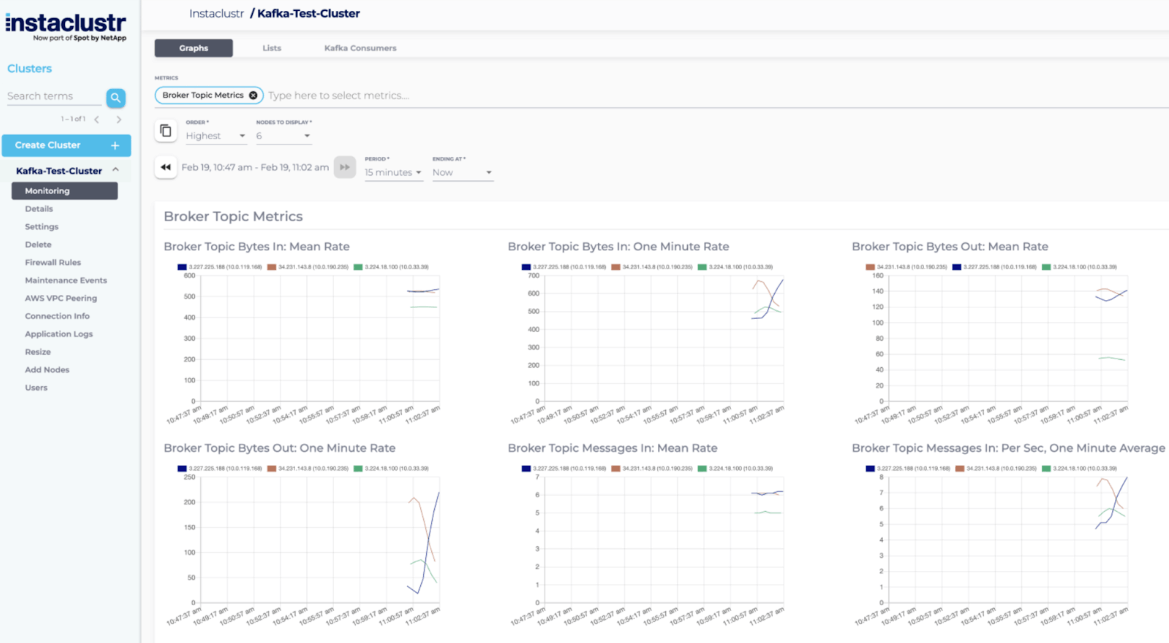
1. NetApp Instaclustr

Best for: Teams wanting fully managed open source Kafka on any cloud or on-prem
Strengths: High-availability SLAs, expert 24/7 support, no proprietary lock-in
Things to consider: Smaller review footprint than the largest cloud providers
NetApp Instaclustr for Apache Kafka is a fully managed service that runs Kafka clusters in the cloud or on-premises, handling provisioning, scaling, upgrades, and monitoring. Users can spin up production-ready clusters through a console, API, or Terraform provider without needing deep Kafka expertise.
The service runs 100% open source Kafka and can be deployed in the customer’s own cloud provider account or Instaclustr’s. It supports dynamic scaling for fluctuating workloads and provides built-in redundancy and automatic failover. Kafka Connect and managed mirroring via MirrorMaker 2 are available as add-ons for building data pipelines and cross-region topologies.
Key features include:
- Deployment and provisioning: Clusters can be launched in minutes through the console, API, or Terraform provider. The service applies tested configurations so users do not have to handle broker tuning or cluster setup manually.
- Scaling and availability: Kafka can scale horizontally by adding or removing nodes, and both up and down to control cost. Built-in redundancy and automatic failover are included, with enterprise deployments using dedicated ZooKeeper or KRaft nodes carrying a 99.999% availability SLA and standard deployments a 99.99% SLA.
- Managed upgrades and maintenance: The service applies Kafka and operating system patches and version upgrades, including automated migration from ZooKeeper to KRaft mode, reducing manual maintenance windows.
- Security and compliance: Data is encrypted in transit and at rest, with role-based access control and private networking. The platform holds SOC 2, ISO 27001, and ISO 27018 certifications and supports PCI-DSS and HIPAA compliance.
- Monitoring and support: Built-in monitoring tracks broker health and cluster metrics, and a 24/7 team of Kafka specialists is alerted when action is needed. Kafka Client Telemetry provides broker-integrated visibility into client and application-level metrics.
- Kafka Connect and mirroring: Managed Kafka Connect provides low-code connectors between data layer products. Managed mirroring via MirrorMaker 2 replicates data between regions, supports active/active topologies, and can maintain a failover cluster.
- MCP gateway for AI workloads: A Model Context Protocol gateway gives AI applications and agents standardized, governed access to Kafka data infrastructure, supporting workflows such as retrieval-augmented generation and recommendation systems.
Limitations (as reported by users on G2):
- Usage-based pricing complexity: Charges depend on cluster size, node type, storage, and support level, so estimating total monthly cost can require some planning for teams new to the model.
- Feature roadmap pace: Some comparative reviews note that other providers were preferred for feature updates and roadmap direction, which teams tracking the latest capabilities may want to evaluate.
- Smaller community footprint: As a managed open source provider, the user community and volume of public reviews are smaller than those of the largest cloud vendors, which can mean fewer third-party guides.
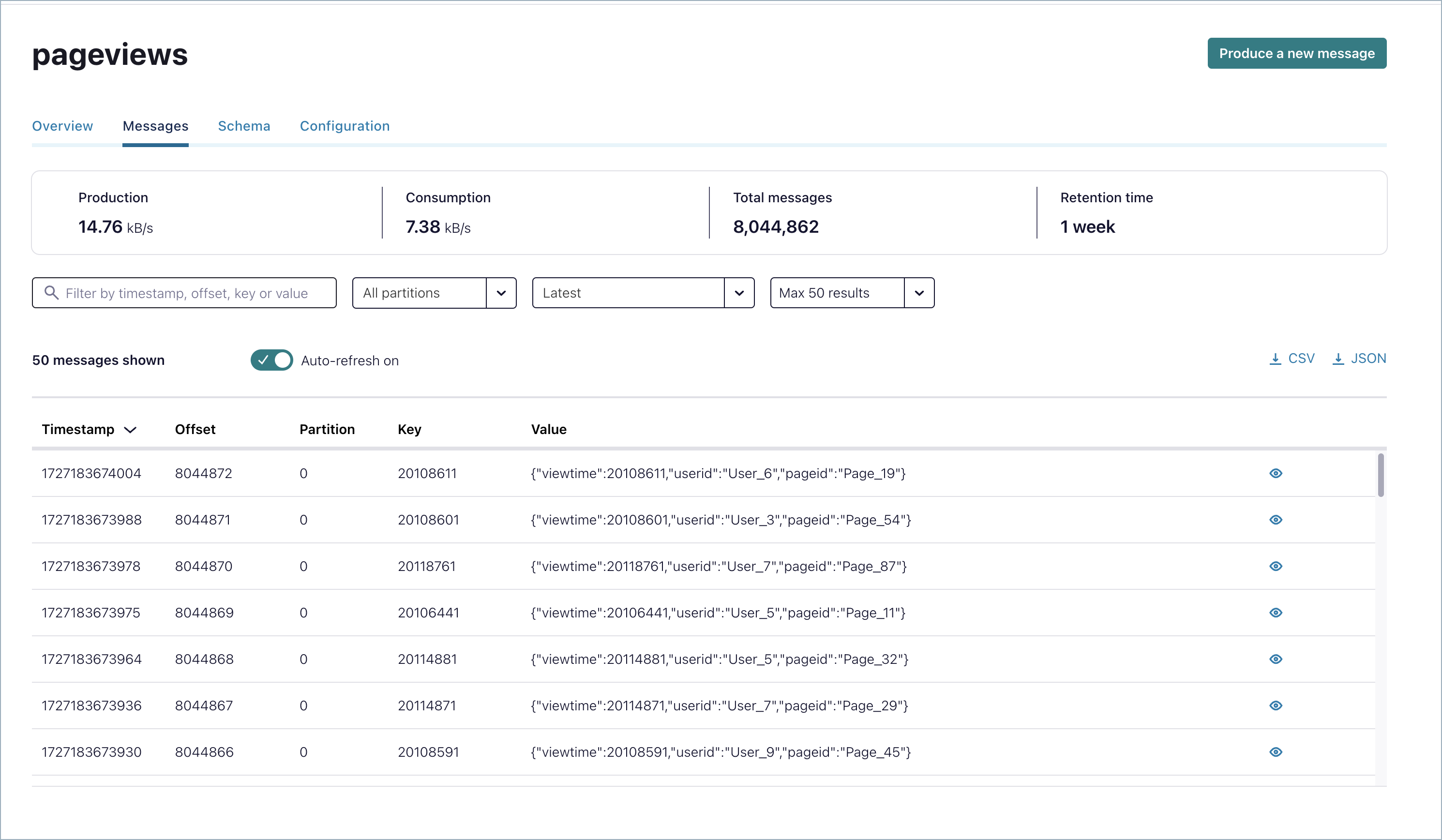
2. Confluent Cloud

Best for: Organizations wanting a broad streaming platform beyond core Kafka
Strengths: Serverless autoscaling, 120+ connectors, Flink stream processing
Things to consider: Learning curve for advanced features and connector limits
Confluent Cloud is a fully managed deployment of Confluent’s data streaming platform, built on the Kora cloud-native Kafka engine. It runs on AWS, Microsoft Azure, and Google Cloud across more than 100 regions and removes the need to install, patch, or scale Kafka server components. Confluent is now an IBM company following the acquisition completed in March 2026.
Beyond core Kafka, the platform bundles connectors, stream processing, governance, and analytics table integration. Clusters come in Basic, Standard, Enterprise, and Freight tiers, with autoscaling and infinite storage available at higher tiers.
Key features include:
- Autoscaling clusters: The Kora engine automatically scales cluster capacity to match workload, so users avoid over-provisioning. Cluster tiers range from Basic and Standard through Enterprise and high-volume Freight clusters.
- Managed connectors: The platform offers 120+ pre-built connectors and 80+ fully managed connectors for databases, data lakes, and data warehouses, removing the need to build and self-manage connector infrastructure.
- Stream processing with Flink: Confluent Cloud for Apache Flink provides serverless stream processing to filter, join, and enrich data, and integrates with AI model inference for building processing pipelines.
- Stream governance: Stream Governance includes a schema registry, stream lineage, and quality controls to manage data at the source and prevent breaking changes across teams.
- Tableflow for analytics: Tableflow materializes Kafka topics and schemas as Apache Iceberg and Delta Lake tables, feeding data lakes and warehouses without separate export pipelines.
- Security controls: The service provides role-based access control, encryption of data at rest and in transit, self-managed encryption keys, audit logs, and private networking, with FedRAMP Moderate authorization available for government workloads.
- Hybrid and multicloud linking: Cluster Linking replicates and syncs data between clusters across regions, clouds, and organizations, and connects to self-managed Confluent Platform and in-account WarpStream deployments.
Limitations (as reported by users on G2):
- Learning curve for advanced features: Users report that advanced capabilities carry a steep learning curve and can require additional time to master beyond initial setup.
- Connector configuration limits: Some Kafka Connect configuration settings are not exposed on all connectors, and certain limits cannot be overridden, which can constrain custom setups.
- Cost at scale: Reviewers note the service can become expensive, and cost estimation for consumption-based billing is cited as a challenge for some teams.
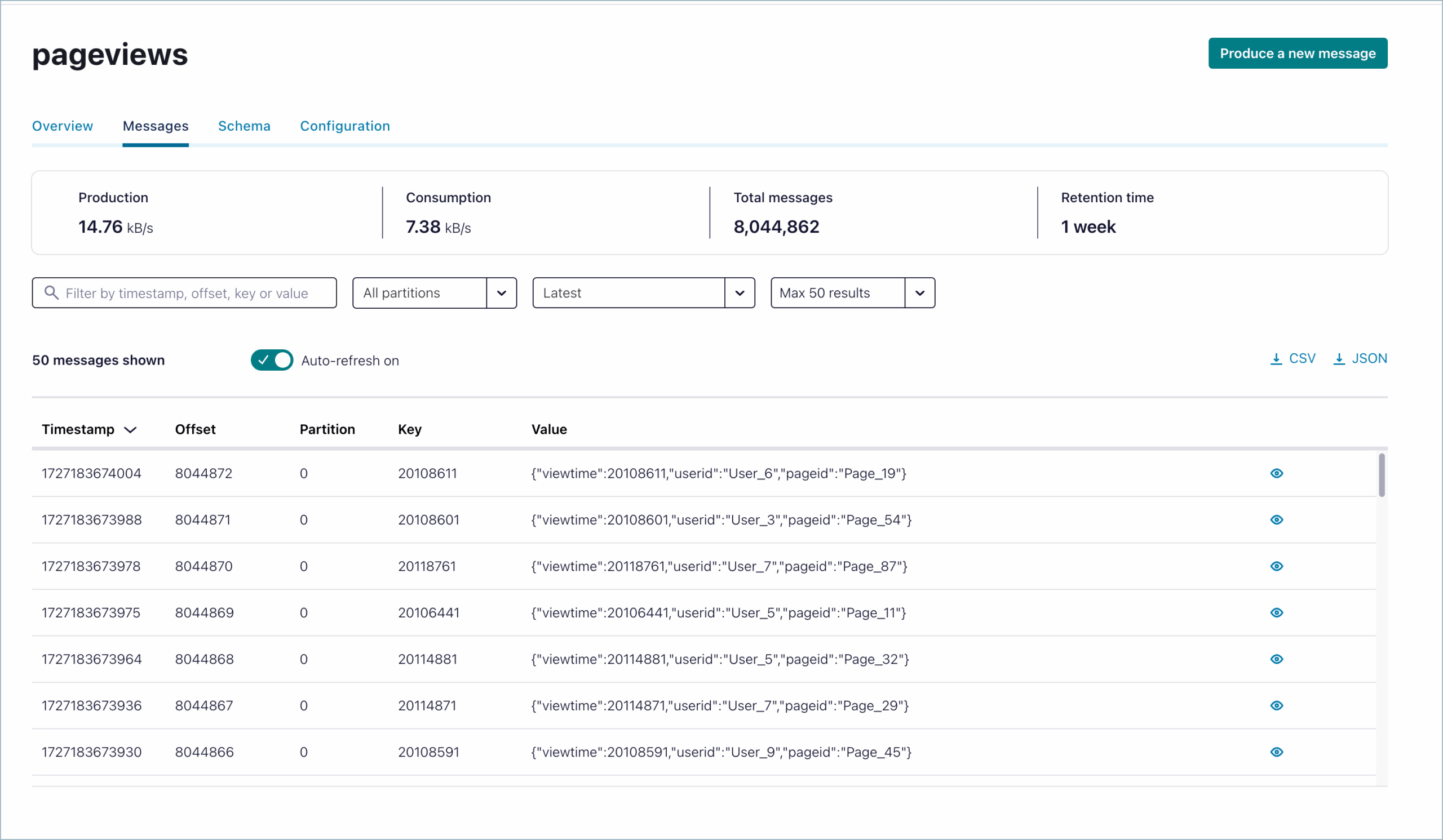
Source: Confluent
Cloud provider-native Kafka services
3. Amazon MSK
Best for: AWS-centric teams running Kafka with native AWS integrations
Strengths: Express brokers, multi-AZ resilience, pay-as-you-go pricing
Things to consider: Limited autoscaling and integration flexibility versus rivals
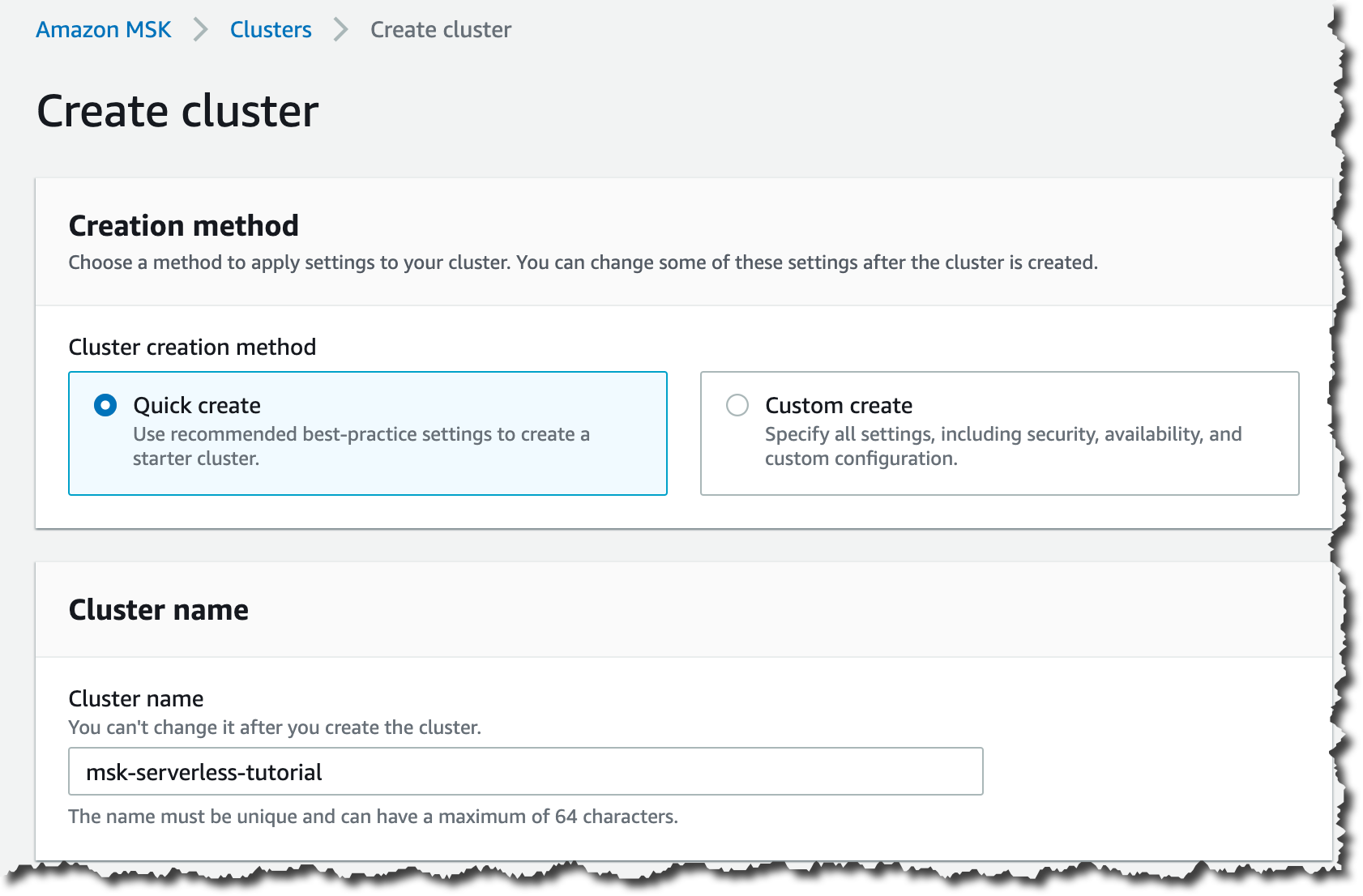
Amazon Managed Streaming for Apache Kafka (Amazon MSK) is a fully managed service that operates, maintains, and scales Apache Kafka clusters on AWS. It runs open source versions of Kafka, so existing applications, tooling, and community plugins work without code changes.
MSK provides control-plane operations for creating, updating, and deleting clusters while users interact with standard Kafka data-plane operations. It detects and recovers from common broker failures automatically and integrates with other AWS services for security, schema governance, and stream processing.
Key features include:
- Managed cluster operations: MSK provisions, configures, and maintains Kafka and Kafka Connect clusters, lowering operational overhead for provisioning and ongoing management.
- Express brokers: MSK Express brokers provide up to 3x more throughput per broker, scale up to 20x faster, recover about 90% quicker than standard brokers, and support up to 5x more partitions per broker.
- Resiliency and availability: Multi-AZ deployments with automated detection, mitigation, and recovery keep workloads resilient, and MSK replaces unhealthy brokers automatically, reusing storage where possible.
- Managed connectors: Fully managed and no-code integrations source data from upstream systems and deliver to downstream systems, with connectors hosted on fully managed Kafka Connect.
- AWS service integration: MSK integrates with AWS IAM and Certificate Manager for security, AWS Glue Schema Registry for schema governance, and services such as Lambda for stream processing.
- Migration tooling: MSK Replicator replicates data across MSK clusters in the same or different regions, and topic data and metadata can be migrated from on-premises, AWS, or other Kafka-compatible deployments.
- Pay-as-you-go pricing: Pricing is based on broker runtime, storage used, and standard data transfer, with no minimum fees or upfront commitments and no charge for in-cluster replication traffic.
Limitations (as reported by users on PeerSpot):
- Limited autoscaling: Users report that MSK lacks flexible autoscaling, which can increase operational overhead when managing cluster capacity.
- Configuration and documentation: Reviewers describe configuration as complex and note documentation gaps and outdated material that can complicate initial setup.
- Integration flexibility and cost: Integration flexibility is reported to lag behind some competitors, schema support for environments such as .NET is cited as needing improvement, and costs can rise significantly at scale.
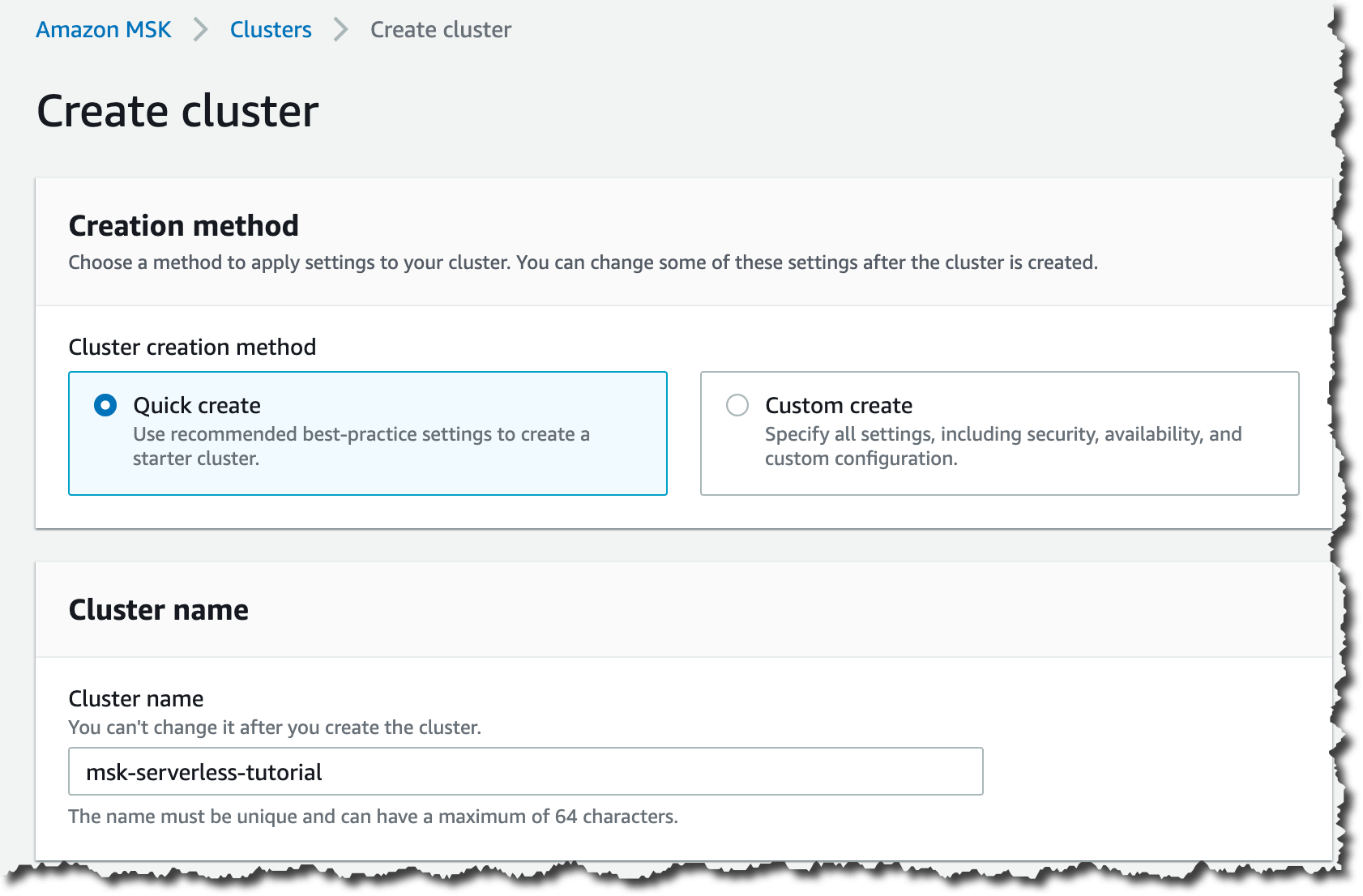
Source: Amazon
5. Azure Event Hubs for Apache Kafka

Best for: Azure users wanting a Kafka endpoint without managing clusters
Strengths: No brokers to manage, multi-protocol support, Azure integration
Things to consider: Not full Kafka; some broker-level features unavailable
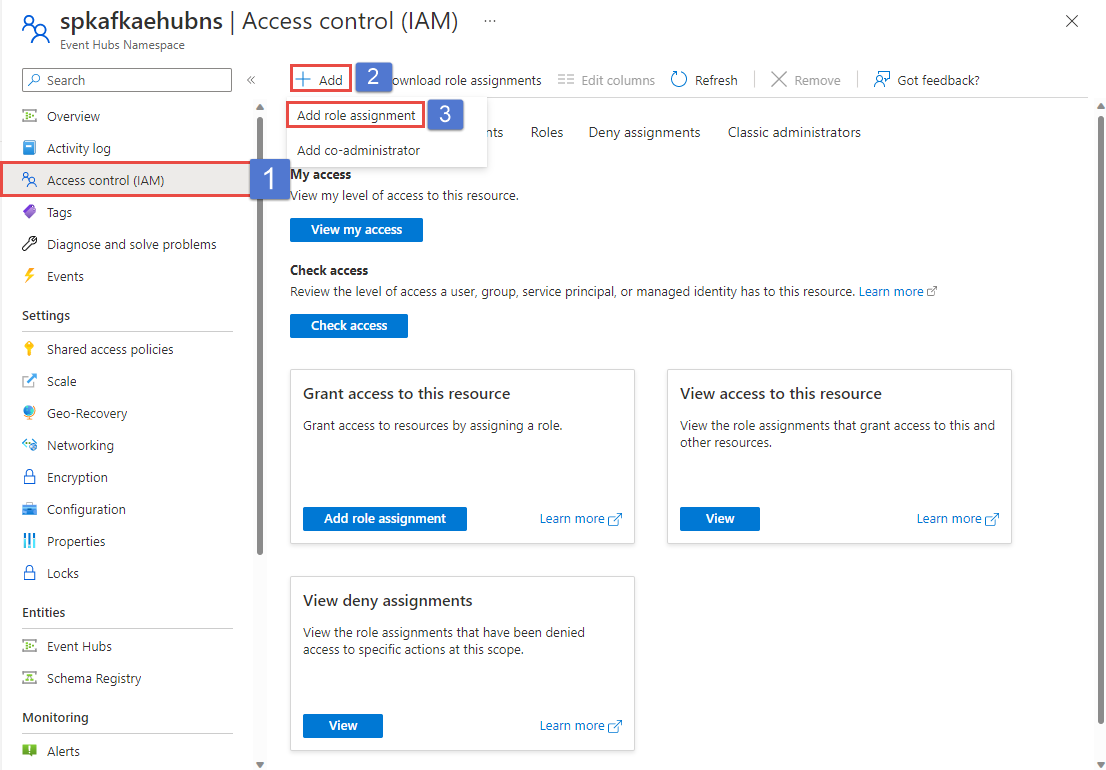
Azure Event Hubs is a fully managed, real-time data streaming service that exposes an Apache Kafka endpoint, letting existing Kafka clients and applications connect without code changes. It is a cloud-native broker engine developed by Microsoft that supports the Kafka RPC protocol alongside AMQP 1.0 and HTTPS, rather than running Apache Kafka code itself.
Because there are no brokers to configure, users interact with Event Hubs as a managed service. It ingests millions of events per second with configurable retention, and integrates with Azure services such as Stream Analytics, Functions, and Blob or Data Lake Storage.
Key features include:
- Kafka protocol endpoint: Event Hubs implements the Kafka producer and consumer APIs for clients version 1.0 and later, so applications point to Event Hubs with configuration changes rather than code changes.
- Event ingestion and retention: The service continuously ingests events from many sources with low latency and configurable time-based retention of 1 to 90 days depending on tier.
- Elastic scaling: Throughput scales from megabytes to terabytes, and the auto-inflate feature automatically increases throughput units to meet demand, with dedicated clusters providing reserved capacity.
- Event Hubs Capture: Capture writes streaming data to Blob storage or Data Lake Storage for long-term retention and micro-batch processing on the same stream.
- Azure schema registry: Azure Schema Registry provides a central repository for managing event streaming schemas and supporting data consistency across applications.
- Azure ecosystem integration: Native integration with Stream Analytics, Functions, and Databricks supports building serverless streaming pipelines and downstream processing.
- Geo-disaster recovery: Geo-disaster recovery and geo-replication features keep data processing running during regional emergencies.
Limitations (as reported by users on G2):
- Not a full Kafka implementation: Event Hubs exposes a Kafka endpoint but does not run Kafka code and has no brokers to configure, so workloads depending on broker-level behavior or certain Kafka features may need another path.
- Learning curve: Users report the service can be hard to grasp for those without strong cloud platform knowledge, and suggest documentation could be clearer.
- Limited flexibility: Reviewers note that some internals are hidden, so achieving more flexible or custom behavior can require writing additional functions.
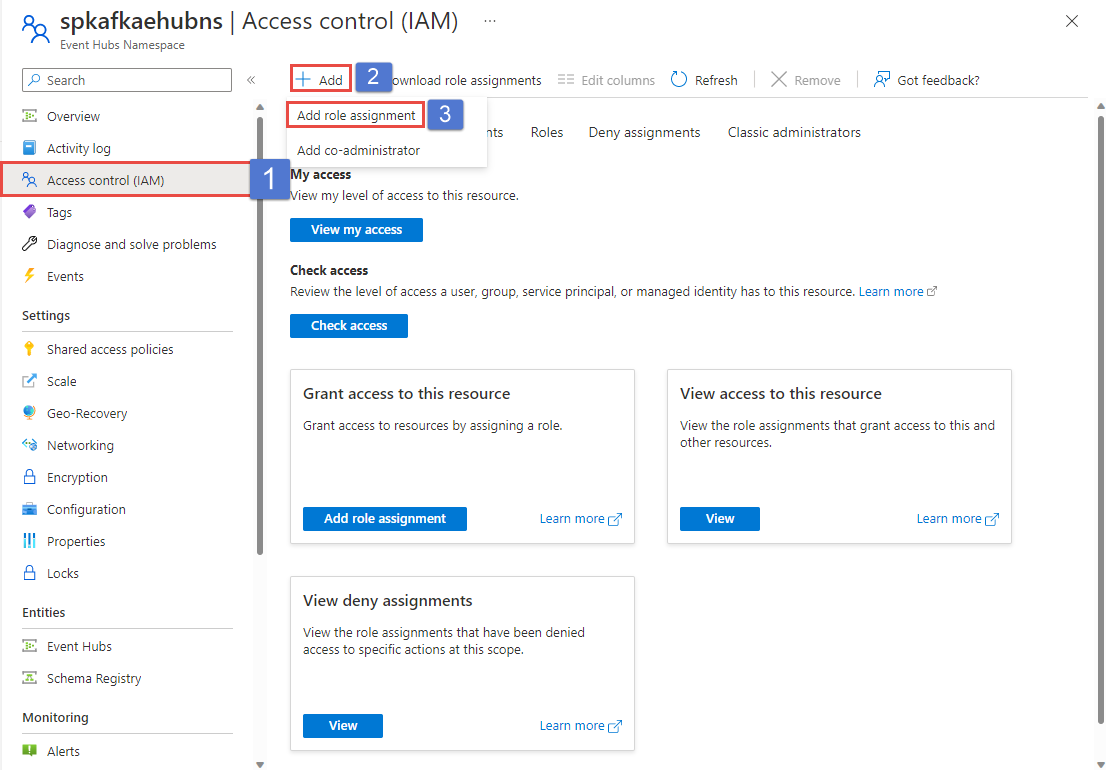
Source: Microsoft
6. Google Cloud Managed Service for Apache Kafka
Best for: Google Cloud teams streaming data into BigQuery and analytics
Strengths: Automatic broker sizing, GCP IAM and VPC integration
Things to consider: Newer service; schema registry and Connect features in preview
Google Cloud Managed Service for Apache Kafka runs open source Apache Kafka clusters on Google Cloud and reached general availability, having previously been known as Apache Kafka for BigQuery. It handles broker resizing, storage management, and other operational tasks so teams do not manage that infrastructure directly.
The service works with existing Kafka applications and runs open source Kafka and Kafka Connect code. To size or scale a cluster, users set the total vCPU count and RAM, and the service automates broker provisioning and can rebalance partitions across brokers.
Key features include:
- Automated broker management: The service handles cluster creation with automatic broker sizing and rebalancing, and all deployments are highly available by default, with automatic version updates keeping clusters on a recent Kafka version.
- Compatibility and portability: It runs open source Apache Kafka and Kafka Connect and implements the Confluent Schema Registry REST API, supporting Avro and Protobuf schema formats, with schema registry and Connect features in preview.
- Data integration with Kafka Connect: Kafka Connect support lets teams migrate and replicate Kafka clusters or write data to BigQuery and Cloud Storage for lakehouse use cases.
- Security and access controls: The service integrates with Google Cloud IAM, customer-managed encryption keys, and Virtual Private Cloud, and deploys clusters in tenant projects on a private VPC without public IP access.
- Automatic patching: When the service discovers vulnerabilities, it patches clusters automatically, and resource isolation gives each project a dedicated tenant project and service agent account.
- Monitoring and logging: Out-of-the-box Cloud Monitoring and Cloud Logging provide observability, and mutual TLS certificate-based authentication is supported for brokers.
- Remote MCP server: A remote Model Context Protocol server lets LLM agents create and manage Kafka clusters, Connect clusters, topics, consumer groups, connectors, and ACLs, with the global endpoint generally available.
Limitations (based on publicly available sources):
- Preview-stage features: Several capabilities including the schema registry API, Kafka Connect, and regional MCP endpoints are in preview and may have limited support until general availability.
- Schema format constraints: The schema registry supports Avro and Protobuf but does not support JSON, which can require adjustments for applications relying on JSON schemas.
- Networking limitations: Documentation notes the service does not support public client access, so connectivity is through private networking within Google Cloud, which affects certain external client setups.
Cloud-native object-storage streaming platforms
6. Redpanda Cloud

Best for: Teams wanting a Kafka-compatible platform with data sovereignty options
Strengths: C++ engine, tiered storage savings, BYOC and serverless options
Things to consider: Some serverless and cloud tier limits reported by users
Redpanda Cloud is a fully managed streaming data platform that is compatible with the Kafka API and based on the Redpanda engine written in C++. It includes automated upgrades and patching, data and partition balancing, built-in connectors, and 24/7 support, backed by a 99.99% uptime SLA on dedicated clusters.
The service offers three cluster models to match different needs: BYOC clusters hosted on the customer’s cloud, dedicated clusters on Redpanda’s infrastructure in AWS, GCP, or Azure, and serverless clusters on shared, isolated infrastructure. It provides a complete streaming environment in a single service, including brokers, HTTP proxy, and schema registry.
Key features include:
- Kafka API compatibility: Redpanda is compatible with Kafka APIs and the broader Kafka ecosystem tooling, allowing existing clients and connectors to work without changes.
- Deployment models: BYOC clusters run in the customer’s own VPC with Redpanda managing provisioning, monitoring, and maintenance while data and credentials stay in the customer environment; dedicated and serverless options are also available.
- Resource efficiency: The platform reports running on about 3x fewer compute resources on average than Apache Kafka, and its tiered storage delivers up to 8-9x savings on long-term data retention costs.
- Tiered storage: Tiered storage offloads data to object storage for cost-effective long-term retention while keeping data queryable through the Kafka API.
- Built-in connectors: Redpanda Connect provides 300+ connectors for systems such as MongoDB, Snowflake, S3, MySQL, and PostgreSQL, with declarative YAML pipelines.
- Redpanda Console: An integrated console gives visibility into topics, consumer group management, and real-time data exploration for development and debugging.
- Raft-native reliability: A Raft-native architecture provides data safety at scale, with automatic cluster balancing, managed upgrades and patching, and multi-cloud deployment across AWS, GCP, and Azure.
Limitations (as reported by users on G2):
- Serverless and cloud tier limits: Users report certain limits on the serverless and cloud versions that can affect specific workloads.
- Cluster stability response: Some reviewers ask for faster and more proactive reaction to cluster stability issues.
- Self-hosted configuration gaps: The Helm chart for self-hosted deployment is described as workable but missing some secrets configuration options.
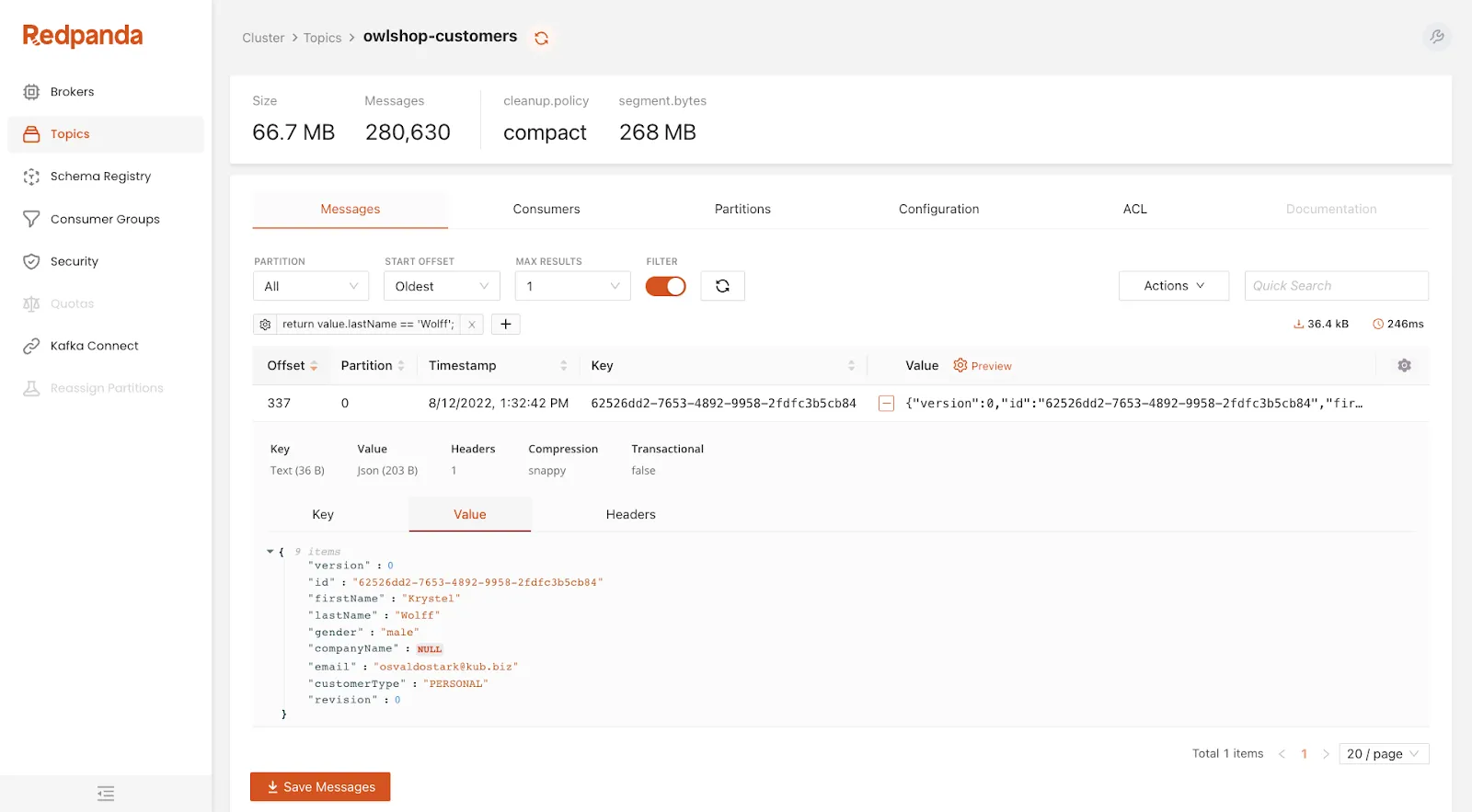
Source: Redpanda
7. WarpStream
Best for: Cost-sensitive, latency-tolerant workloads needing data sovereignty
Strengths: Zero-disk architecture, no inter-AZ fees, stateless agents
Things to consider: Higher latency than local-disk Kafka; some feature gaps
WarpStream is a Kafka-compatible data streaming platform that runs on object storage rather than broker-local disks. It replaces stateful Kafka brokers with a single stateless Agent binary that speaks the Kafka protocol, and its Bring Your Own Cloud model runs entirely in the customer’s cloud account. WarpStream is a Confluent product, and Confluent is an IBM company.
In the BYOC model, Agents run on the customer’s compute and store data in the customer’s object storage buckets, so raw data never leaves the customer environment and WarpStream hosts only the control plane metadata. The stateless design removes local disks, inter-AZ replication, and partition rebalancing.
Key features include:
- Zero-disk architecture: WarpStream eliminates local disks by writing directly to S3-compatible object storage, reducing storage costs by more than 24x compared to local EBS volumes.
- No inter-AZ networking fees: Because Agents do not manually replicate data between availability zones, the inter-zone networking fees that make up a large share of Kafka costs are eliminated.
- Stateless auto-scaling: Stateless Agents can scale by simply adding or removing containers, with no partition or broker rebalancing, KRaft controller management, or capacity planning required.
- Zero-access security model: WarpStream ingests only metadata and personnel have no access to customer data or the deployment environment, so data and credentials stay within the customer VPC.
- Orbit migration: Orbit performs offset-preserving replication from any self-hosted or cloud-hosted Kafka source, including topics, consumer groups, ACLs, and cluster configurations, for zero-downtime migration.
- Schema registry and governance: A Confluent-compatible BYOC schema registry supports Avro, JSON, and Protobuf and validates schemas during production and consumption, with data governance features in the customer’s account.
- Multi-region clusters and Agent Groups: Multi-region clusters provide zero data loss with automatic failover, and Agent Groups isolate workloads at the network layer within a single logical cluster across VPCs, regions, or clouds.
Limitations (based on publicly available sources):
- Higher produce latency: WarpStream’s documentation and independent analysis note higher produce latency than traditional Apache Kafka because writes go to object storage, though it is tunable as a cost versus performance trade-off.
- Feature gaps versus Kafka: Independent reviews note that Kafka compatibility is not complete, with some features such as transactions historically unsupported, so teams should verify feature parity.
- Idempotent producer throughput: Documented known issues describe that enabling the idempotent producer in some client libraries can result in poor throughput and high latency without careful tuning.
9. AutoMQ

Best for: Teams seeking a diskless Kafka drop-in with elastic scaling
Strengths: S3-based storage, second-level scaling, full Kafka compatibility
Things to consider: Newer entrant with a smaller published review base
AutoMQ is a Kafka-compatible streaming platform that runs Kafka directly on object storage such as S3, GCS, and Azure Blob. It re-architects Kafka’s storage layer to make brokers stateless while maintaining 100% compatibility with the Kafka wire protocol, APIs, and ecosystem tools such as Kafka Connect, Strimzi, and Schema Registry.
By offloading data to object storage, AutoMQ decouples compute from storage so brokers can scale in seconds and partitions can be reassigned without moving data. It is offered as a BYOC service managed in the customer’s cloud account, and as software for platform teams that manage their own Kubernetes delivery.
Key features include:
- Cloud-native storage: AutoMQ stores data on object storage, providing durable and effectively unlimited capacity where teams pay only for what they store, without EBS volumes or RAID configuration.
- Stateless brokers: Brokers hold no persistent local data, so they auto-scale in seconds without capacity planning or partition reassignment, and can run on spot instances.
- Zero cross-AZ traffic: Clients connect to local-zone brokers and shared object storage eliminates replica synchronization, removing cross-AZ data transfer costs.
- Fast partition reassignment: Because scaling requires only metadata updates with no inter-broker data movement, partition reassignment completes in seconds rather than hours.
- Kafka compatibility: AutoMQ is 100% compatible with Apache Kafka APIs as a drop-in replacement, using Kafka’s KRaft for metadata and working with existing applications and ecosystem tools without code changes.
- Auto-balancing and elasticity: An auto-balancer redistributes traffic and partitions across brokers automatically, and built-in elasticity adjusts capacity to demand under a usage-based model.
- Ecosystem solutions: The platform adds a table topic feature that converts topics into Iceberg or Delta Lake tables, 300+ managed connectors, zero-downtime migration from Kafka via AutoMQ Linking, and multi-cluster disaster recovery.
Limitations (based on publicly available sources):
- Newer market entrant: AutoMQ is a relatively new platform with a smaller base of published third-party reviews than long-established Kafka services, so independent validation is more limited.
- Object-storage latency profile: As with other object-storage designs, latency characteristics differ from local-disk Kafka; the vendor reports higher multi-AZ and cross-cloud latencies than single-AZ, which teams with strict latency needs should benchmark.
- Operational ownership in software mode: The self-managed software option requires platform teams to own Kubernetes delivery, scheduling, and infrastructure tuning in-house.
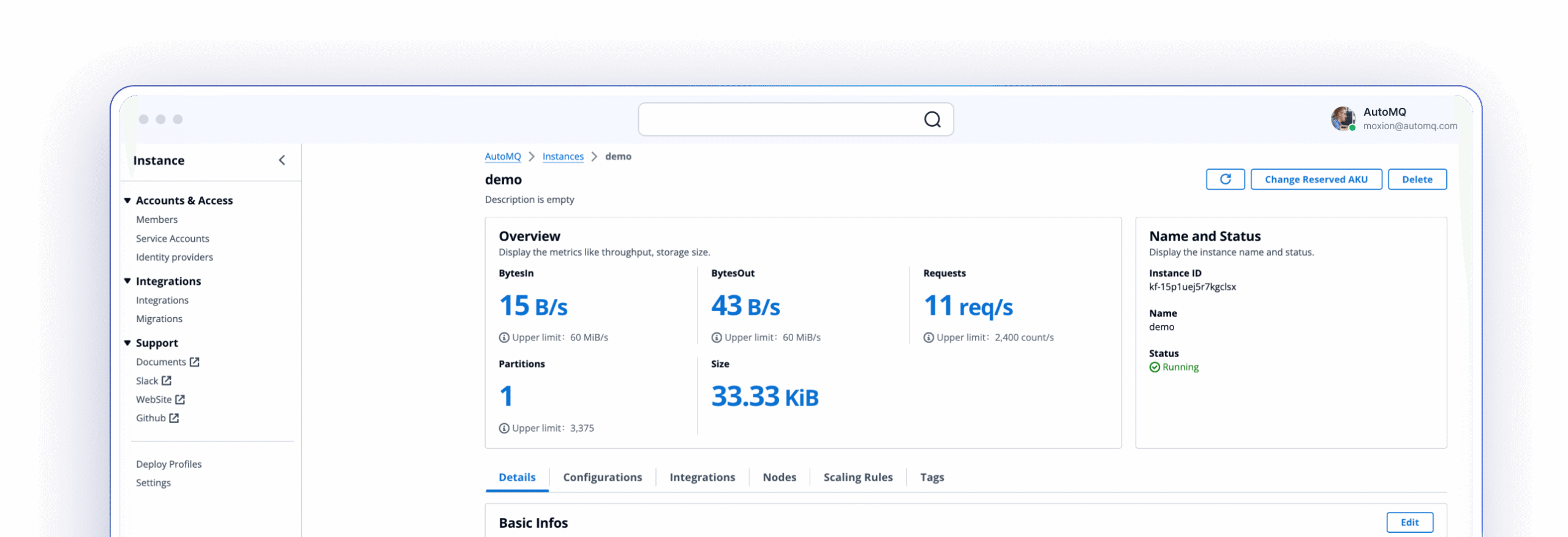
AutoMQ
Conclusion
Hosted Apache Kafka services provide a streamlined way to adopt real-time streaming without the complexity of deploying and maintaining distributed infrastructure. By combining automated operations, elastic scalability, built-in security, and expert support, these platforms enable organizations to focus on building data-driven applications and architectures. The result is faster project delivery, reduced operational risk, and the flexibility to scale seamlessly as data volumes and business requirements evolve.