Five years ago, the search and analytics landscape shifted in a way that felt, at the time, like a crisis. In January 2021, Elastic changed the license for Elasticsearch and Kibana to the Server Side Public License. The change effectively closed off the software to cloud providers and, in many cases, to organisations building managed services on top of it. Within weeks, a fork was announced. By July 2021, OpenSearch 1.0 was generally available.
What has happened since is an unusual open source story: a project born out of a licensing dispute has become an enterprise-grade platform with AI-driven search at its core, governed by the Linux Foundation, running at scale across some of the world’s most demanding environments. At NetApp Instaclustr, we’ve been involved from the beginning, and the fifth anniversary feels like a good moment to look back at what that has meant for us and, more importantly, for our customers.
Why we got involved in OpenSearch
The honest answer is that we didn’t have to think very hard about it.
Instaclustr was built on a simple premise: organisations should be able to run the open source data technologies they trust, fully managed, without vendor lock-in and without the operational burden that usually comes with it. When Elastic moved to SSPL, a gap opened up. Customers who had built on Elasticsearch for log pipelines, application search, and observability needed certainty. They needed to know the technology they depended on would stay open, stay supported, and stay available on their terms.
OpenSearch was the answer the community gave to that need. We chose to stand behind it.
That support meant building a managed OpenSearch service, investing in compatibility testing across every version, and making a long-term bet on a project that, in those early months, was still proving itself. Over time that commitment deepened into direct participation in the project itself. Today we have two active OpenSearch contributors in Muneer Kolarkunnu and Carlos Rolo, and two OpenSearch ambassadors on the team in Amanda Katona and Carlos Rolo.
The first three years: Building managed OpenSearch alongside the project
OpenSearch 1.0 was a faithful fork of Elasticsearch 7.10, built on the Apache 2.0 license with a community-driven development model. From day one, we made it available on the Instaclustr managed platform so customers could adopt it without having to run the infrastructure themselves.
The move from 1.x to 2.x in May 2022 was the project’s first significant step beyond its Elasticsearch roots. OpenSearch 2.0 expanded capabilities and established its own release cadence and architecture. On our side, this meant delivering new features to customers as they became available: cross-cluster replication for resilience, the Alerting and Anomaly Detection plugins for operational intelligence, and OpenSearch Dashboards for visualisation. Each new capability expanded the range of problems customers could solve.
For our customers, this meant distributed, performant, reliable search at scale. A platform you could build your search stack around with confidence.
What we heard from customers across this period was consistent. They valued the managed layer not because they couldn’t run OpenSearch themselves, but because keeping up to date with patching, backups and operations can take several full time engineers. Outsourcing that to NetApp Instaclustr was both more cost effective and delivered a better result.
Using our managed platform for OpenSearch saved them time and money on operations. Upgrades, backup management, monitoring, scaling: all of it is necessary for a production service, but expensive in engineering time. Abstracting that away let teams focus on building search experiences, not managing clusters.
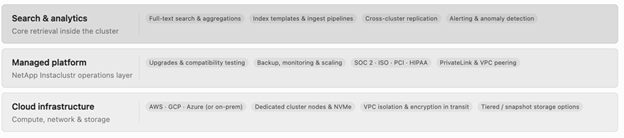
Figure 1 – The layers of OpenSearch on the NetApp Instaclustr Managed Platform
2023–2024: Enterprise-ready managed OpenSearch and independent governance
Those first few years also brought enterprise-grade infrastructure to our managed OpenSearch offering. Compliance certifications including SOC 2, ISO 27001, ISO 27018, PCI-DSS, and HIPAA became part of the standard offering. Availability SLAs strengthened. Network isolation options like PrivateLink and VPC Peering made it practical to use managed OpenSearch inside strict security perimeters.
At the project level, September 2024 brought a significant change. The OpenSearch Software Foundation was established under the Linux Foundation, moving the project from AWS stewardship to independent governance with input from multiple stakeholders. For organisations that had been cautious about depending on technology controlled by a single cloud provider, it resolved a real concern.
The independent governance aligned with the same reasons they’d chosen OpenSearch in the first place: an open source search platform with a future shaped by the community around it.
2024–2026: The AI turn for OpenSearch AI search
The biggest shift of the past five years wasn’t a version number. It was the arrival of vector and semantic search.
When k-NN vector search and the Neural Search plugin landed in OpenSearch, they opened up a new category of problems the platform could address. Search that understood meaning, not just matching keywords. Retrieval that could power RAG pipelines feeding large language models. Hybrid approaches that combined semantic similarity with traditional relevance scoring to produce results that matched what users actually wanted.
In October 2025, we launched public preview of AI Search for OpenSearch on the NetApp Instaclustr managed platform. The GA release followed in March 2026, adding support for external LLM and embedding services including Amazon Bedrock and OpenAI, and opening broader use cases for OpenSearch AI search.
The applications our customers are building look different from anything that was possible five years ago: enterprise knowledge bases with conversational search interfaces, e-commerce discovery that understands product intent without exact keyword matches, support systems that retrieve relevant answers rather than returning a list of documents, and observability pipelines where anomaly detection is guided by language models.
We knew that our customers wanted powerful, trustworthy search without added operational complexity. That hasn’t changed. If anything, the arrival of ML infrastructure has made it more relevant, because the operational overhead of running models at scale is considerable.
OpenSearch 3.7, released in June 2026, represents where the platform stands at its fifth birthday: 5.5× faster k-NN vector retrieval, an improved hybrid search optimiser with 82 scoring variants, and the foundations of agentic AI integration through the OpenSearch Agent Server. This is not the same technology we put into production in 2021. It is now central to how teams think about OpenSearch AI search, retrieval, and production AI pipelines.

Figure 2 – OpenSearch major release milestones
Looking ahead: Managed OpenSearch for search and AI pipelines
Our commitment to OpenSearch has never been stronger and we continue to build the features around it that customers need to run search and AI pipelines reliably at scale.
GPU node support for OpenSearch is in testing on our platform. Early results point to much faster vector indexing compared to CPU-based approaches, which matters for the large-scale embedding workloads that AI search applications generate. OpenSearch 3.6 and 3.7 features are moving through compatibility testing and will be available to managed platform customers in the coming months.
The project itself continues to grow: 13,000+ GitHub stars, a global community of contributors, and an active conference schedule across three continents. CERN joined the OpenSearch Software Foundation in April 2026. Those aren’t the metrics of a transitional project filling a licensing gap. OpenSearch has a serious future ahead of it.
When OpenSearch launched in 2021, AWS committed to “a long-term investment in the OpenSearch project.” Five years in, that’s a phrase we’d use to describe our own position. Our commitment has always been grounded in the same principle that drew us to it in 2021: open source infrastructure should be accessible to every organisation, regardless of whether they have the engineering capacity to run it themselves. That hasn’t changed, and it won’t.
If you’re exploring OpenSearch, whether you’re evaluating it for the first time or looking to modernise an existing deployment, we’d welcome the conversation.
If you’d rather just jump straight in and get hands-on with OpenSearch and its AI capabilities, simply head over to our console for a free 30-day trial.