What is a managed open source database?
A managed open source database is a cloud-based service built on open source technologies, such as PostgreSQL, Apache Cassandra, or MySQL, but operated, automated, and maintained by a third-party provider. These services handle administration, monitoring, patching, scaling, and backup, allowing organizations to focus on their applications.
Adoption of these services is expanding quickly: industry analyses value the open source database market in the billions of dollars and project sustained double-digit annual growth, fueled by enterprise adoption and cloud database integration.
The provider ensures the database runs reliably, securely, and efficiently, combining the flexibility of open source with operational convenience. Unlike traditional open source databases, where enterprises manage infrastructure, tuning, and maintenance, managed solutions eliminate the need for deep in-house expertise or resource-intensive support teams.
This model accelerates deployment and lets organizations use popular open source platforms without operational complexity. It appeals to enterprises looking for reliability, scalability, and predictable performance, while benefiting from open source innovations and avoiding vendor lock-in associated with proprietary products.
Demand for these services continues to climb as enterprises modernize their data estates and build AI applications. Industry research values the open source database market in the billions of dollars with steady double-digit annual growth, driven by enterprise adoption, cloud-native architectures, and rising analytics needs.
A growing share of platforms now embed AI-driven automation and vector search to support retrieval-augmented generation and other modern AI workloads.
Editor’s note: Updated the article to add recent market research, AI-driven database automation, and vector search trends, plus a new section on these capabilities, as of 2026.
This is part of a series of articles about open source AI
Key features of managed open source databases for enterprise
Enterprise-grade reliability and performance
Managed open source databases for enterprise environments prioritize high availability, redundancy, and failover mechanisms. Providers often implement automated backups, point-in-time recovery, and proactive health monitoring to ensure applications remain online even during failures. Performance optimization is integrated through hardware tuning, intelligent caching, and load balancing, offering low-latency access and consistent throughput suitable for mission-critical operations.
Increasingly, providers apply AI-driven automation to these operations, using machine learning for self-tuning, predictive query optimization, and intelligent indexing that detect performance bottlenecks and apply corrective measures in real time.
Scalability is another major factor. Managed solutions allow enterprises to scale their database clusters horizontally or vertically in response to demand, through simple configuration changes or automation. This approach supports workload bursts and global user bases without service interruption or manual intervention.
Security and compliance
Security is addressed at multiple layers within managed open source databases. Providers implement features such as encryption at rest and in transit, fine-grained access controls, network isolation, and regular vulnerability patching. These security features are critical for organizations that manage sensitive or regulated data, reducing the risk of unauthorized access or breaches.
Compliance is equally important for enterprises in regulated industries. Managed service providers often offer compliance certifications, such as SOC 2, HIPAA, or GDPR readiness, built into the platform. Automated auditing, logging, and user activity monitoring help organizations meet regulatory requirements without additional tooling.
Cloud-native, fully managed services
Being cloud-native, managed open source databases exploit the elasticity, automation, and integration features of the cloud environment. Providers handle provisioning, patching, version upgrades, and redundancy across global infrastructure, eliminating common sources of human error associated with manual operations. Disaster recovery and disaster avoidance are also built-in. Many platforms are moving toward autonomous operation, where self-managing and self-healing capabilities handle routine administration and recovery with minimal manual intervention.
Users benefit from integrated operations tooling, telemetry, and APIs for monitoring, alerting, and controlling their database environments. Customers can focus on database schema and data modeling rather than infrastructure, improving developer productivity and accelerating the pace of delivery for new products and services.
Rich feature sets and extensibility
Managed open source databases come with a suite of features, including built-in analytics, full-text search, partitioning, support for multiple data models, and advanced indexing. By using open source engines, enterprises benefit from active community innovation, which translates quickly into new or improved capabilities for managed offerings. Add-ons and integrations, such as business intelligence connectors or backup gateways, further expand the platform. A notable recent addition is native vector search, which lets teams store and query high-dimensional embeddings for semantic search and retrieval-augmented generation directly alongside their operational data.
Extensibility is another advantage, as these databases typically offer RESTful APIs, language bindings, and plugin architectures for customizing storage, logic, and data flows. Enterprises can integrate managed open source databases into broader technology stacks, connect to ETL pipelines, or build analytics workflows with minimal friction.
Flexible deployment and hybrid architectures
Managed open source databases support a variety of deployment models, from fully cloud-based to hybrid cloud or on-premises configurations. Such flexibility allows enterprises to meet data residency, latency, or integration needs tailored to business or regulatory constraints. Hybrid and multi-cloud support enables seamless data movement and redundancy across different environments.
This flexibility extends to workload distribution and disaster recovery strategies, letting organizations design architectures optimized for resilience, compliance, or latency requirements. Enterprises can leverage cloud bursting for seasonal spikes or utilize on-premises deployments for applications with strict compliance mandates.
Learn more in our detailed guide to open source databases
AI-driven automation and vector search in managed databases
Managed open source databases are increasingly shaped by artificial intelligence, both in how they are operated and in the workloads they support. On the operations side, providers apply machine learning to automate performance tuning, resource allocation, predictive maintenance, and self-healing, reducing administrative overhead and cutting manual intervention for tasks that once required dedicated database administrators.
The autonomous database management market is growing rapidly, reflecting enterprise appetite for systems that provision, tune, patch, scale, and secure themselves. Recent moves by major providers include AI-powered query plan optimization, ML-driven workload routing, and automated data layout tuning that lower latency and compute costs without hands-on performance work.
At the same time, managed platforms are adding native vector search so teams can store and query high-dimensional embeddings next to their operational data. This supports retrieval-augmented generation, semantic search, and agentic AI applications, with hybrid search that combines vector similarity, keyword matching, and metadata filtering now treated as a core requirement rather than a niche feature.
For enterprises, these capabilities mean a single managed service can increasingly power both traditional transactional workloads and AI-driven applications. Consolidating vectors, caching, and operational data reduces the number of systems to keep in sync and simplifies building production AI on open source foundations.
Popular managed open source database services for enterprise
1. NetApp Instaclustr

Instaclustr offers a fully managed service for open source technologies, enabling businesses to focus on their applications rather than database administration. With Instaclustr, organizations gain access to enterprise-grade capabilities, robust security, and unparalleled support freeing teams from the complexities of managing database infrastructure.
Key capabilities of Instaclustr:
- Fully managed service: End-to-end management of clusters, including provisioning, monitoring, maintenance, and scaling.
- Automated backups and updates: Automated backups and seamless updates, ensuring data integrity and up-to-date software.
- High availability: Minimized downtime, through redundant architecture and failover support that keeps databases running 24/7.
- Performance optimization: Integrated performance tuning and monitoring tools achieve consistently efficient and reliable database operations.
- Security built-in: Benefit from robust encryption and secure architecture, ensuring data is protected at every layer.
- Integration and support: Seamlessly integrate with other tools in the tech stack and rely on expert support available 24/7.
- Achieve optimal outcomes for GenAI projects: Enhance AI outcomes with vector search capabilities and move GenAI projects from pilot to production.
Source: NetApp Instaclustr
2. Amazon RDS for PostgreSQL

Amazon RDS is a managed relational database service that supports open source engines like PostgreSQL and MySQL. It automates administrative tasks such as provisioning, patching, and backups, enabling faster deployment and easier operations.
General features include:
- Multi-engine support: Managed deployments for PostgreSQL, MySQL, MariaDB, and others with configuration flexibility
- Automated administration: Handles provisioning, patching, backups, and monitoring with minimal manual effort
- Scalable infrastructure: Easily adjust compute, memory, and storage to match workload needs
- Performance optimization: Optimized reads/writes and support for AWS Graviton3-based instances
- Read replicas: Improve performance and scalability with support for multiple replicas per instance
- Flexible deployment: Run in the cloud or on-premises using Amazon RDS on Outposts
Enterprise features include:
- High availability: Multi-AZ deployments with automated failover ensure uptime and business continuity
- Security and compliance: Follows AWS security best practices and supports encryption at rest and in transit
- Cost optimization: Offers multiple pricing models and Aurora I/O-Optimized options for predictable performance and lower costs
- Operational maturity: Backed by over a decade of AWS database experience, with continuous innovation and support
- Integration with Aurora: Access features like Aurora Serverless and zero-ETL integration with Redshift for real-time analytics
Source: Amazon RDS
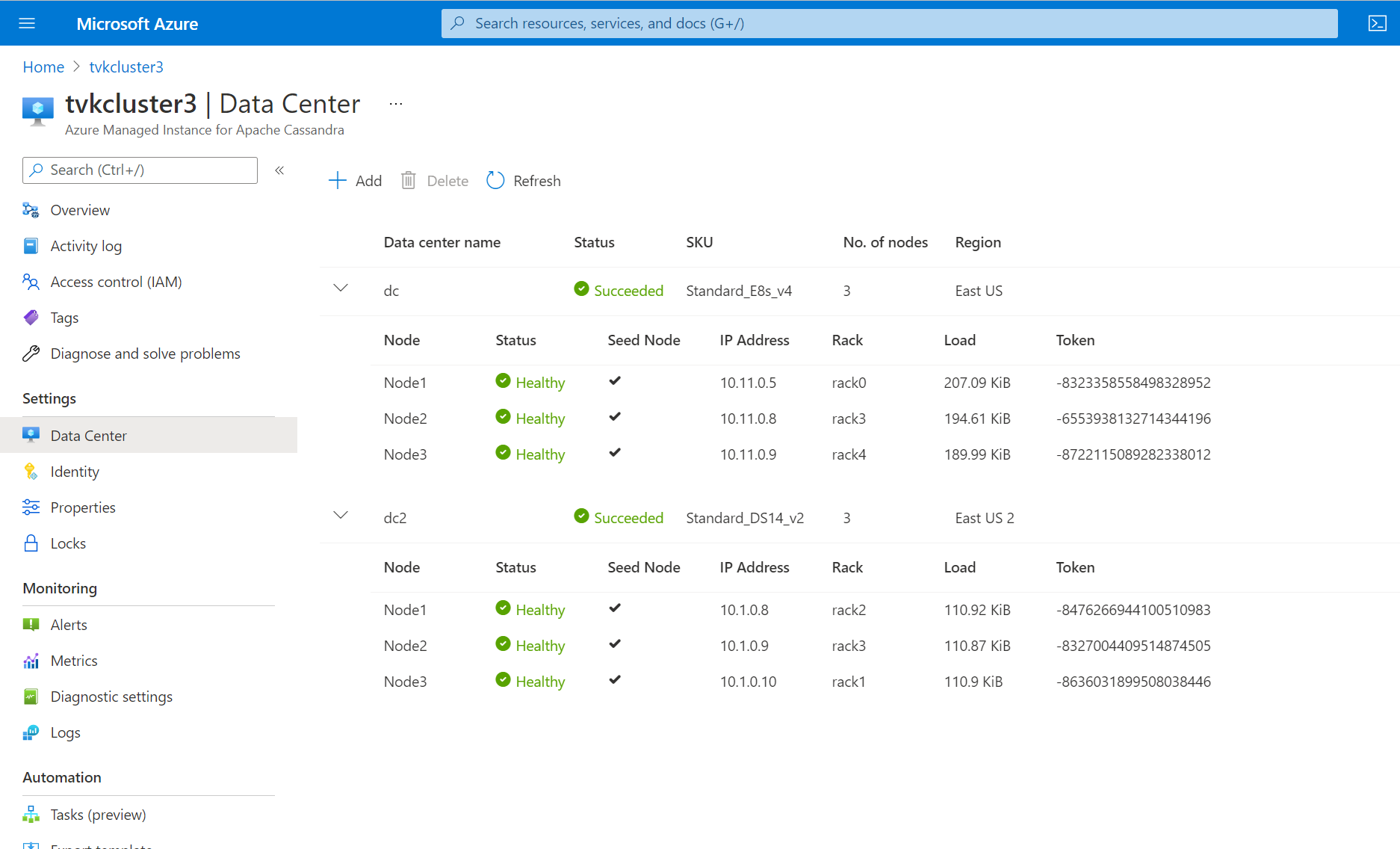
3. Azure Managed Instance for Apache Cassandra

Azure Managed Instance for Apache Cassandra is a managed service that provides open-source Apache Cassandra clusters with cloud-native automation, monitoring, and scalability. It enables developers to override default configurations to match their workload requirements.
General features include:
- Fully managed clusters: Automates common tasks such as provisioning, scaling, patching, monitoring, and repairs
- Hybrid deployment support: Connects Azure-hosted Cassandra data centers with existing on-premises or multi-cloud Cassandra clusters
- Customizable configurations: Allows configuration overrides at the datacenter level to fine-tune performance and behavior
- Simplified scaling: Can scale nodes up or down with a single command; scale orchestration is handled automatically
- Metrics and monitoring: Exposes metrics through Prometheus, Grafana, and Azure Monitor for observability and diagnostics
Enterprise features include:
- Integrated support and SLAs: Offers 24×7 support with proactive performance advice, infrastructure issue mitigation, and guaranteed SLA for data center availability
- Health monitoring: Actively monitors nodes, virtual machines, and infrastructure with automated failure recovery mechanisms
- Secure by default: Includes OS and Cassandra-level patching, certificate rotation, and vulnerability scanning with minimal service disruption
- Granular restore options: Supports partial restores (keyspace or table level) and flexible backup restore targets (existing or new clusters)
- Azure ecosystem integration: Native compatibility with Azure Virtual Network, ExpressRoute, and Azure Blob Storage for backup storage

Source: Microsoft
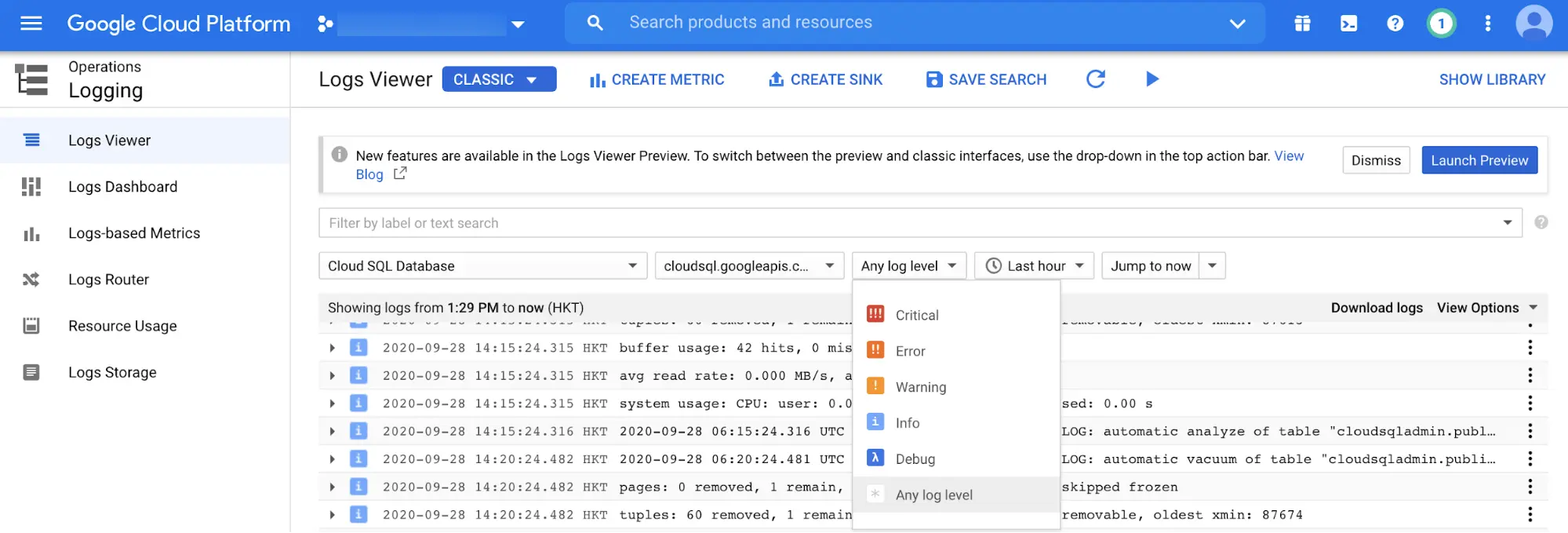
4. Cloud SQL for PostgreSQL Managed Database

Cloud SQL for PostgreSQL is a managed relational database service that brings open source PostgreSQL capabilities to Google Cloud with automation, performance, and security. It simplifies database operations with automated backups, patching, high availability, and integrated observability tools.
General features include:
- PostgreSQL compatibility: Supports major PostgreSQL versions and popular extensions, with over 100 tunable flags
- Integrated developer tools: Seamlessly connects to pgAdmin, Percona Monitoring, and Firebase Data Connect
- Automatic backups and PITR: Daily backups and point-in-time recovery enable protection against accidental data loss
- Flexible instance shapes: Independently scale compute, memory, and storage resources to meet workload needs
- Simple scaling: Add read replicas, scale storage automatically, and grow up to 96 cores, 624 GB RAM, and 60 TB storage
Enterprise features include:
- Managed security: Data encrypted in transit and at rest, with support for customer-managed encryption keys (CMEK)
- Access controls: IAM-based authentication, audit logging, VPC integration, and firewall rules provide secure, managed access
- Regulatory compliance: Meets standards like HIPAA, ISO 27001, SSAE 16, and PCI DSS, with features for data residency and Access Transparency
- Zero-downtime maintenance: Automated patching and upgrades with downtime of less than 10 seconds and customer-configurable maintenance windows
- Database migration service: Simplifies migrations from PostgreSQL and Oracle with serverless, secure tools
Source: Google
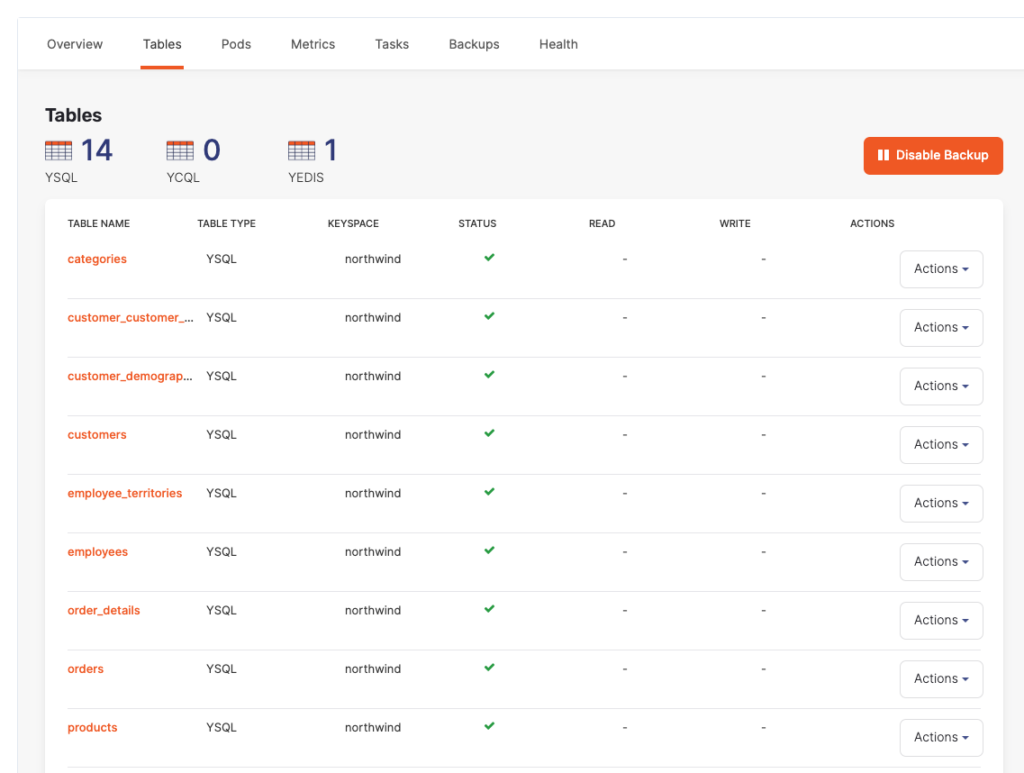
5. YugabyteDB

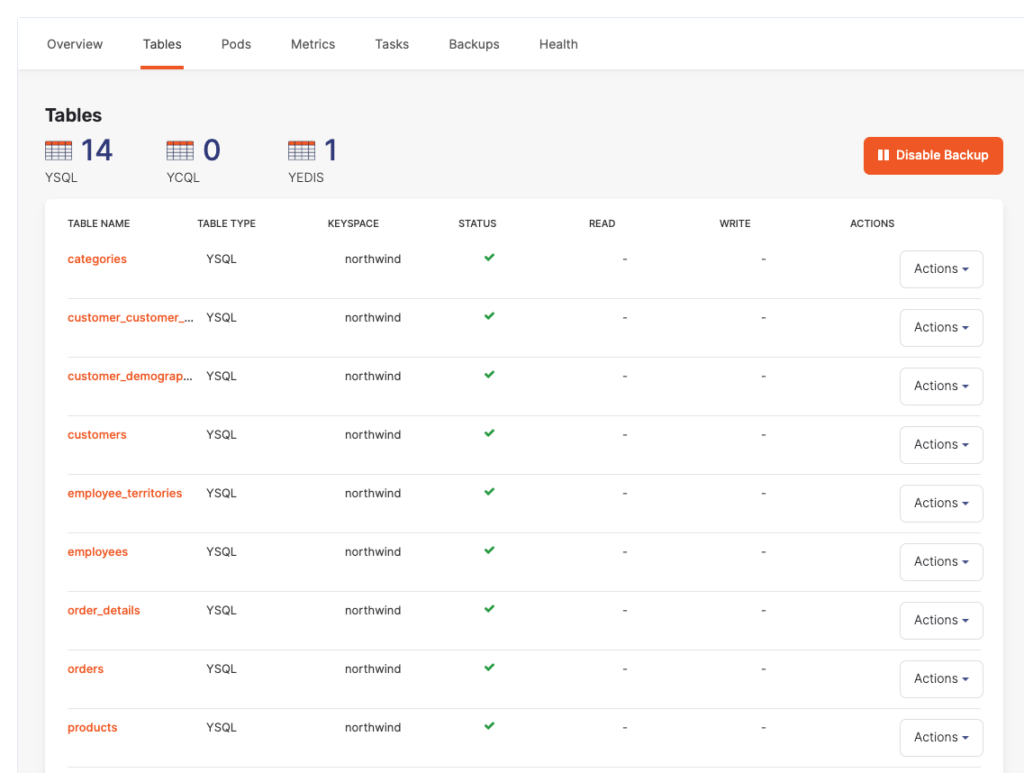
YugabyteDB is a distributed, PostgreSQL-compatible database for cloud-native applications that require high resilience, scalability, and global data distribution. It combines the relational and transactional model of PostgreSQL (YSQL) with the distributed performance characteristics inspired by Cassandra (YCQL).
General features include:
- PostgreSQL and Cassandra compatibility: Offers two APIs, YSQL for PostgreSQL compatibility and YCQL for Cassandra-style access
- Distributed SQL engine: Automatic sharding and replication across nodes ensures scale and resilience with ACID compliance
- Connection management: Integrated pooling supports high concurrency with faster connection creation
- Smart drivers: Topology-aware drivers eliminate the need for external load balancers, adapting to changes in cluster topology
- Vector search support: Perform SQL-based similarity searches with support for large-scale vector indexing across clusters
Enterprise features include:
- Geo-distribution: Natively distribute data across regions with synchronous or asynchronous replication for performance and compliance
- Built-in high availability: Resilient architecture ensures continuous availability with automated failover and fault recovery
- Security by design: End-to-end encryption, advanced authentication, and support for enterprise-grade identity systems
- Multi-cloud support: Deploy across public, private, or hybrid clouds with consistent operations and no vendor lock-in
- No-downtime upgrades: Perform rolling software and infrastructure upgrades without disrupting database availability
Source: YugabyteDB
Related content: Read our guide to open source data platform
Considerations for choosing a managed open source database for enterprise
Choosing a managed open source database for enterprise use involves evaluating a range of technical, operational, and strategic factors. While these platforms promise reduced overhead and increased agility, not every solution fits all workloads or organizational requirements. Below are key considerations enterprises should weigh before selecting a provider or platform:
- Workload suitability: Assess whether the database’s data model and consistency guarantees align with the target workload.
- Operational transparency: Evaluate how much visibility and control you retain over infrastructure operations, performance tuning, and configurations. Some services offer deep customization; others prioritize simplicity with limited control.
- Compliance and data residency: Ensure the platform meets regulatory obligations such as GDPR, HIPAA, or industry-specific certifications. Verify where data is stored and whether data residency requirements can be enforced, particularly for global operations.
- Integration with existing systems: Review how well the managed database integrates with current cloud services, development workflows, and monitoring tools. Native compatibility with platforms like Kubernetes, Terraform, or enterprise IAM solutions can significantly reduce friction.
- Scalability and flexibility: Consider whether the database supports horizontal or vertical scaling, and whether scaling is automatic or manual. Also evaluate support for hybrid or multi-cloud architectures, especially if you have latency-sensitive or geo-distributed workloads.
- SLAs and support: Check service level agreements (SLAs) for uptime, performance, and support responsiveness. Enterprise-grade deployments often require 24×7 support with guarantees for issue resolution and disaster recovery.
- Vendor lock-in risk: Analyze the level of portability between managed and self-hosted versions of the database. Choose platforms that allow migration without re-architecting applications to avoid long-term lock-in.
- Cost predictability: Examine the pricing model in detail, including storage, compute, networking, and optional features. Understand how the service handles resource bursts or underutilization, and whether autoscaling is cost-optimized.
- Security posture: Verify the provider’s approach to data encryption, vulnerability management, access controls, and incident response. Look for default security configurations and support for enterprise identity management.
- Future roadmap and community health: Consider the pace of development, vendor transparency around roadmaps, and the health of the open source community backing the core engine. A strong ecosystem ensures ongoing innovation and long-term viability.
Conclusion
Managed open source databases enable enterprises to combine the innovation of open source with the operational reliability of managed cloud services. They provide automation, scalability, and security at enterprise scale, while allowing organizations to focus on application development rather than database maintenance. By aligning database strategy with business needs and compliance requirements, enterprises can adopt managed open source platforms that deliver both agility and long-term resilience.